Working within the EU Cities Mission requires both operations and innovation – but teams can get stuck on only one and miss the complementary benefits of the other. To help them overcome this familiar problem, NetZeroCities partners from the Technical University of Madrid introduce a method to examine and redirect their activities.
During a rainy spring in Spain in 2025, players from central and city government, business, academia and other institutions were coming together to advance an ambitious goal and speed up building renovations on a large scale.
But they met a familiar constraint: responsibilities and resources were scattered across municipalities, regions, and ministries. Coordination – not motivation – was the bottleneck.
Meetings between the parties helped clarify competencies, highlight needs, and begin a shared agenda, yet one lesson landed quickly: too many meetings too soon create fatigue, not momentum. The group noted the need for fewer but higher-quality sessions, with clear objectives and structure.
This is where creative stakeholder management begins: not with more engagement, but with better–designed collaboration.
The hidden trap: “We ran the meetings… why aren’t we moving?”
Most stakeholder processes fail in one of two ways:
- They become all about operations: efficiency, delivery, minutes, and action lists. It looks serious. But the system stops learning. New constraints emerge (political timing, regulatory complexity, legitimacy gaps), and suddenly the coalition is brittle.
- They become all about innovation: visioning, ideation, inspiring formats, and broad inclusion. It feels exciting. But budgets, decisions, and implementation pathways don’t move.
Organisational research has a name for this tension: balancing exploitation (refining and executing what you know) with exploration (testing what you don’t). When you over-invest in one side, you lose adaptability or performance.
Working within the EU Cities Mission – like with Climate City Contracts – explicitly demands both: delivery and continuous learning, because the CCC is meant to be a process and a “living” roadmap co-created with stakeholders, including an investment dimension.
‘The two circles’ method
Here’s the practical model: run stakeholder management in two circles, deliberately designed for different jobs.
Circle one: Operations: the delivery engine
This is where you:
- make decisions
- align responsibilities
- translate into plans, timelines, and “who does what”
- reduce ambiguity and track progress
In the Spanish group, operations showed up as structured sessions focused on concrete themes (e.g., planning, financing, regulatory frameworks) and on clarifying the roles of different administrative levels.
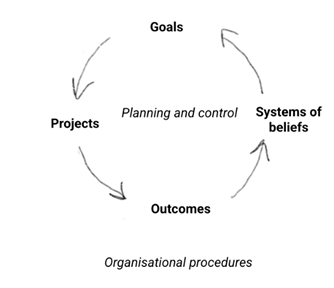
Image 1. Illustrative representation on Operations: planning and control. Atelier itd, Adaptation from Eccles & Goddard
Rule of thumb: Operations meetings should feel slightly boring – in a good way. They create reliability.
Please see our report for more examples of sufficiency policies and governance.
Circle two: Innovation: the learning engine
This is where you:
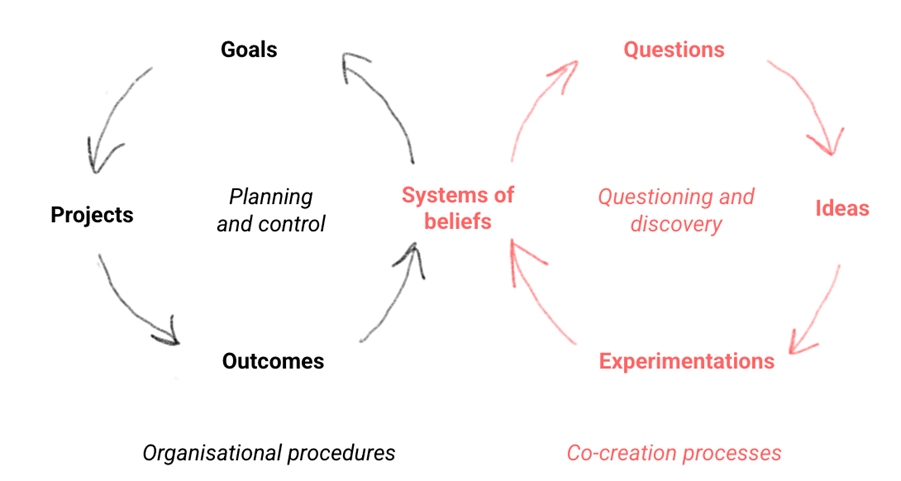
Image 2. Illustrative representation of the Two – Circle Theory: Operations and Innovation. Atelier itd, Adaptation from Eccles & Goddard
- Expand the range of options (new allies, new tools, new policy pathways)
- Clear up misunderstandings early (before they become blockages)
- Make sure any professional jargon is understood by all stakeholders i.e. speak the same language
- Test ideas, even when things are unclear
The same Spanish process makes the needs visible: multi-level governance is complex and shaped by misaligned calendars, fragmented regulation, and political context – you can’t solve that with an action plan alone, you need regular moments to learn and adjust.
Rule of thumb: Innovation meetings should feel slightly uncomfortable – in a good way. They create adaptability.
Creativity lens: networks aren’t just nodes and links – they’re spaces
In many networks, we map the nodes (actors) and the relationships (links). Useful – but incomplete. In practice, what makes a network work is a third element: spaces of encounter, carefully designed, where collaboration is cultivated rather than assumed. That’s why the project reports repeatedly stress the importance of well–planned meeting contexts and the risk of overloading participants.
A simple way to connect this to the two circles:
- Operations tend to use task-focused encounter spaces: project sessions, working groups, decision forums.
- Innovation tends to use sensemaking-focused encounter spaces: cross-sector dialogues, prototyping labs, trust-building moments, “improbable connections.”
Both are needed because networks are not machines. They are living systems of trust, incentives, and meaning.
How to run the two circles without doubling your workload
This is the part managers care about: How do we do this without creating a meeting monster?
1) Separate the cadence (don’t mix circles in the same meeting).
- Operations: weekly/fortnightly, strict agenda, decision log.
- Innovation: monthly/quarterly, facilitated, designed for learning.
This matches what network governance research calls a core challenge: different network forms require different coordination mechanisms, and effectiveness depends on choosing structures that fit complexity.
2) Use one “bridge artifact” that forces translation (understanding what we are doing in both circles).
A one-page table that sits between circles:
- What bottleneck are we trying to unblock?
- What are we delivering now (operations)?
- What are we testing or learning (innovation)?
- What decision will that learning inform, and by when?
This is the practical expression of organisational ambidexterity: execute and adapt at the same time.
3) Design innovation as disciplined creativity, not brainstorming.
Creative stakeholder management isn’t “ideas on sticky notes.” It is reframing constraints into design questions, for example:
- “How do we convince regions?” → “What value would make coordination rational for regions?”
- “How do we get buy-in?” → “What commitments are safe enough to start, but real enough to matter?”
4) Invest in trust like it’s infrastructure.
Trust and the quality of the relationship are what sustain long-term collaboration, which takes time and continuity. Collaborative governance scholarship agrees: trust-building and shared understanding are central to effective collaboration.
The real creativity: moving from control to influence
There’s a deeper reason the two circles matter. As soon as you move from an internal team to a coalition, or to a network, you lose direct control. What replaces it is influence, built through credibility, reciprocity, and well-designed spaces.
In mission-oriented work, this is not a soft skill. It is a delivery capability.
A quick self-check
If your stakeholder management feels stuck, ask:
- Do we have an operations circle that reliably turns conversations into decisions?
- Do we have an innovation circle that keeps us adaptive as the system shifts?
- Are our encounter spaces designed for quality over quantity?
When both circles run well, something changes: stakeholders stop being “people to manage” and become a network that can actually move a mission.
The ideas in this blog are based on applied research by itdUPM and Atelier itd on collaboration and network development, synthesised by Carlos Mataix (UPM professor; Director of itdUPM) and Nayla Saniour (Atelier itd researcher). The framing is further informed by the work of Goddard and Eccles.