Funding for cities is changing while their responsibilities are increasing – but to shape this change, cities must take part in the process now, says Natalia Lewandowska from NetZeroCities’ partners ICLEI Europe. Recent experience in Poland can show them how.
As the European Union moves closer to defining its next long-term budget one thing is becoming clear: the rules of the game are changing. For cities where climate action is implemented, tested, and scaled, the coming years will require not only new projects, but a fundamentally new mindset around funding.
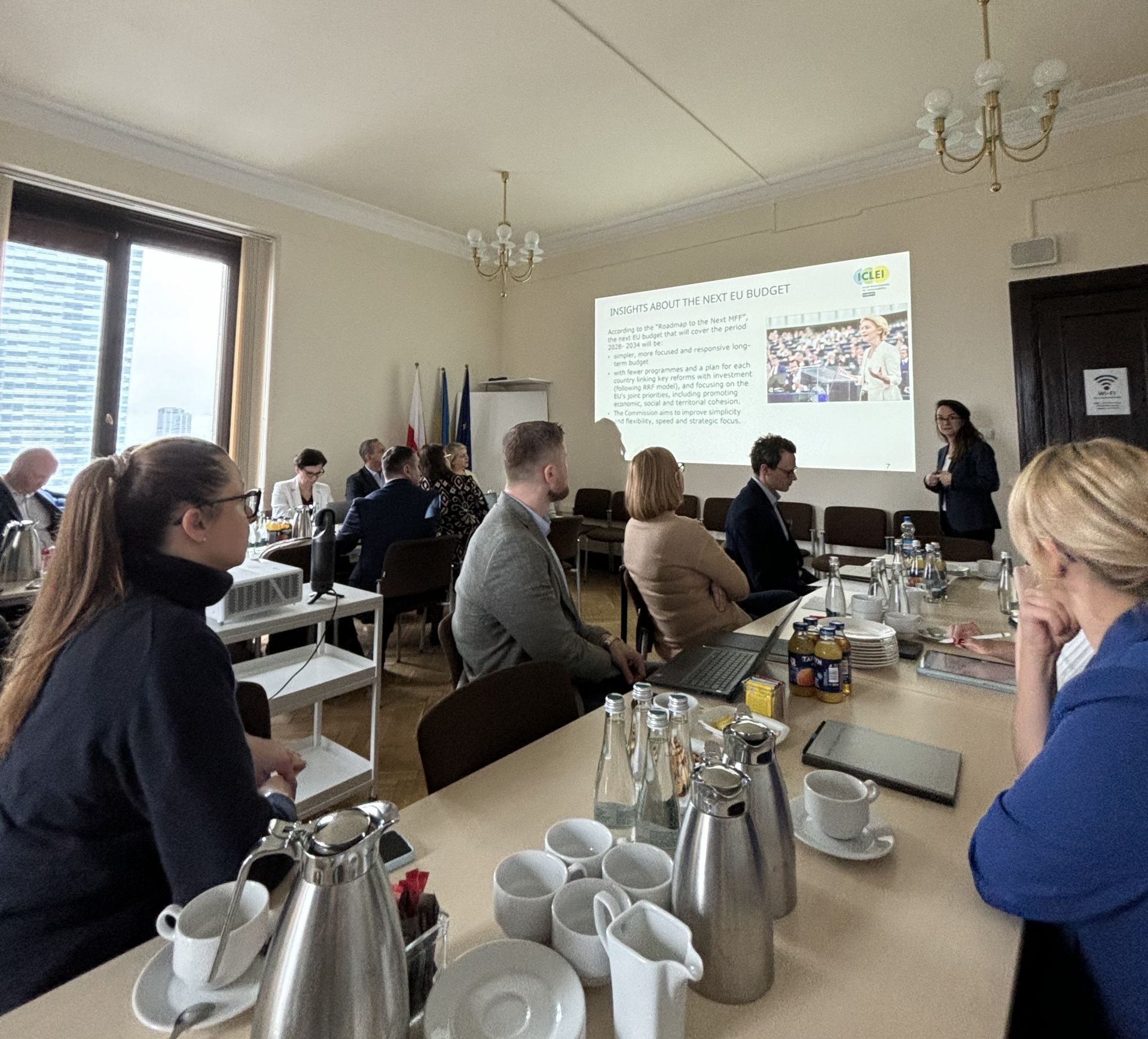
Against this backdrop, a Better Funding Dialogue (BFD) in Poland offered a structured process to help cities, ministries, and national stakeholders prepare for what lies ahead. And while it addressed the Polish concerns, the dialogue highlighted lessons that are relevant beyond its borders.
And perhaps the most important takeaway from these meetings is that the next Multiannual Financial Framework (MFF) perspective does not start in 2028 – it starts now.
The next MFF is the EU’s long-term budget for 2028–2034, setting not only spending priorities but also the rules, instruments, and governance that will shape how funding reaches cities and regions. Although it formally begins in 2028, its direction is being decided now, through consultations and national planning processes that will lock in choices years in advance.
Consultations at the national level are expected to begin in early 2026, with Member States required to submit national plans by mid-2027. Cities that wait may risk having to react to rules designed without them. Cities that engage early can build alliances and rethink their financing models to help shape a system that works for people, places, and the climate.
The future will be different: less pre-defined, more conditional, and more demanding – but also full of opportunity for those who are ready.
What are Better Funding Dialogues?
Better Funding Dialogues respond to a common concern: cities are expected to deliver Europe’s climate and social objectives but are often sidelined when funding rules are designed.
Bringing together national ministries, cities (in particular, Mission Cities and Mission-minded cities), regional authorities, financial institutions, and experts, the dialogues aim to ensure that local governments are not excluded from strategic conversations dominated by national or regional levels; and provide a space where these actors can identify barriers, jointly reflect on future funding frameworks, and co-develop recommendations.
Beyond Poland: why this dialogue matters for all European cities
While the Polish Better Funding Dialogue is embedded in a specific national context, its implications are European. Across the EU, cities face similar challenges: increasing responsibilities, growing investment needs, more complex funding rules, and weaker influence over strategic decisions. At the same time, urban priorities risk being overshadowed by broadened European priorities.
The Polish experience shows the value of early coordination, structured dialogue, and a united voice between cities, regions, and national governments. It also highlights the importance of building strong national platforms, such as the cooperation between NetZeroCities and the Union of Polish Metropolises, an association bringing together Poland’s 12 largest cities, to ensure that cities are not marginalized in regional or national negotiations.
A year-long process: from exchange to recommendations
The first meeting in early 2025 focused on experience-sharing and identifying barriers and opportunities related to the upcoming EU financial outlook. Participants discussed the architecture of the next Multiannual Financial Framework and the growing role of less traditional instruments such as debt-based and blended finance.
The recurring theme was ‘uncertainty’. While the European Commission favours simplification, many cities fear that these changes could weaken existing cooperation models with regions and undermine multi-level governance.
By the time of the third meeting, cities and the Ministry of Development Funds and Regional Policy (MFiPR) were discussing concrete recommendations developed over the course of the year. The conversation had clearly shifted from abstract frameworks to operational realities: indicators, reporting obligations, co-financing rates, and project feasibility.
And critically, these discussions were not the last word on how Polish cities are funded. A clear need has been met and the potential value of more cooperation has been recognised, and so participants are already looking into how the dialogue might continue.
Why the MFF matters for Polish cities
Poland is likely to receive a slightly reduced, yet still the largest development envelope in the EU. How these funds are structured, accessed, and governed will directly affect cities’ ability to deliver climate neutrality, social inclusion, and resilience.
Around 55% of Poland’s population is expected to remain in less-developed regions in the next financial period, while regions such as Śląskie and Pomorskie will move to higher classifications, with co-financing rates dropping to 40%. From 2028 onwards, this will significantly increase national and local co-financing needs.
Despite having mature, ready-to-implement project pipelines, for example under the EU Cities Mission, cities participating in the Dialogue repeatedly stressed that they are too often involved only at the final stages of consultations. What they are asking for is an inclusive co-design process throughout the whole cycle of negotiations.
The current state of MFF negotiations: structure decided, details pending
At EU level, negotiations reached an important milestone in December 2025, when the European Council approved the negotiation boxes. This high-level political agreement confirms that the overall structure of the next MFF is now set. While it does not resolve all open questions, it frames the key trade-offs that will guide the final deal. In the coming six months, under the Cyprus Presidency, discussions will focus on critical issues such as the size of the EU budget and remaining political priorities.
From subsidies to better finance: a necessary mindset shift
One of the most important, and challenging, messages emerging from the Polish Better Funding Dialogue is clear: the era of grants as the default option is ending.
Debt-based instruments, blended finance, and pre-financing models will play a much larger role, yet many local governments remain hesitant, citing lack of competencies, unclear debt classifications, and inadequate regulation for piloting innovative funding schemes. Less traditional financing models are possible, but only where local leadership is willing to take calculated risks and invest in new capacities. Avoiding these discussions today risks leaving cities unprepared tomorrow.
The lesson from the Polish Better Funding Dialogue makes it clear that the next Multiannual Financial Framework will reward preparedness, partnership, and strategic thinking. As funding becomes more conditional and implementation more nationally driven, cities cannot afford to wait for the rules to be finalized before engaging. Those that invest early in dialogue, alliances, and new financing capacities will be better placed not only to navigate change, but to shape a system that delivers for citizens and our climate.
The future of EU funding is therefore already being written – and cities still have a chance to influence how the story unfolds.
The views in this blog belong to the author only and do not represent the views of the European Commission, NetZeroCities, or its partners.