Suffering information overload on sustainability? Bergamo helps citizens cut bills and take part in change with local, expert advice

2026-03-11T09:39:56+01:00March 11th, 2026|

Our societies aren’t short of information, but does everyone have the simple and trustworthy info they need to take action on climate and energy? To solve this in Bergamo, the city launched Energia in Comune, a helpdesk service where locals can get face-to-face guidance from experts. The helpdesk team tells us more on the NetZeroCities blog.  Citizens and businesses are often confronted with difficult questions: how to reduce energy consumption, which incentives apply, whether photovoltaic systems are feasible, or how to participate in energy communities. Without clear guidance, even the most motivated citizens can struggle to move forward.  Bergamo has already laid strong foundations for climate action through its Sustainable Energy and Climate Action Plan (PAESC) and the Climate Transition Strategy Cli.c Bergamo. Yet, like many cities, it [...]

Bringing networks to life: why context matters as much as contacts

2026-03-02T16:22:13+01:00March 2nd, 2026|

Working in networks is widely promoted in public policy, urban innovation, and climate action – but too often, they create more meetings than results and more expectations than impact. NetZeroCities partners at the Technical University of Madrid offer a method to rethink how to get the most from networks. In highly complex environments, real innovation is not about doing more, but about working together better. But why do networks – a necessity for urban transformation – sometimes fail? Building a network is not just about adding people or organisations or even making sure they talk to each other. It’s a [...]

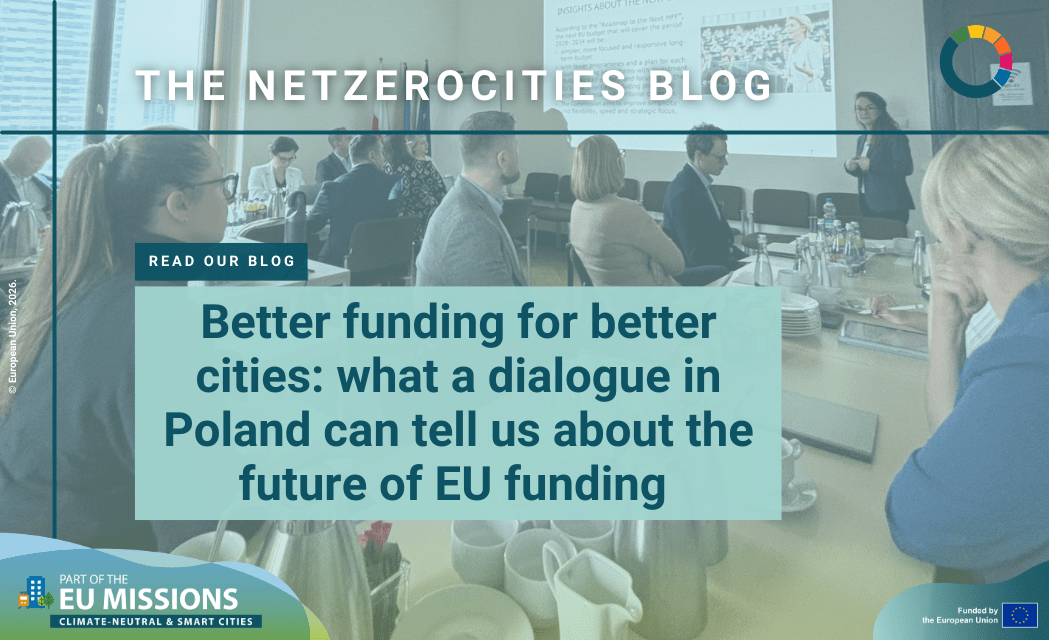
Better funding for better cities: what a dialogue in Poland can tell us about the future of EU funding

2026-03-06T11:56:44+01:00February 24th, 2026|

Funding for cities is changing while their responsibilities are increasing – but to shape this change, cities must take part in the process now, says Natalia Lewandowska from NetZeroCities’ partners ICLEI Europe. Recent experience in Poland can show them how.  As the European Union moves closer to defining its next long-term budget one thing is becoming clear: the rules of the game are changing. For cities where climate action is implemented, tested, and scaled, the coming years will require not only new projects, but a fundamentally new mindset around funding.  Against this backdrop, a Better Funding Dialogue (BFD) in Poland offered a structured process to help cities, ministries, [...]

Climate ambition continues to grow across Europe: Dortmund, Sarajevo and Elbasan awarded the EU Mission Label

2026-02-16T17:48:51+01:00February 16th, 2026|

Three more cities have been recognised for their commitment to climate-neutral and smart city transformation by 2030, bringing the total awarded across Europe to 106 and marking an important geographic milestone. The city of Dortmund joins other German Mission Cities as a recipient of the EU Mission Label, while Sarajevo Functional Urban Area (City of Sarajevo, City of East Sarajevo, and Sarajevo Canton) in Bosnia and Herzegovina and Elbasan in Albania become the first recipients in the Western Balkans, expanding climate action and ambition further across Europe. What the label recognises The EU Mission Label acknowledges [...]

Bringing out the best in climate partners: the ‘two circles’ of creative stakeholder management

2026-02-06T16:21:41+01:00February 6th, 2026|

Working within the EU Cities Mission requires both operations and innovation – but teams can get stuck on only one and miss the complementary benefits of the other. To help them overcome this familiar problem, NetZeroCities partners from the Technical University of Madrid introduce a method to examine and redirect their activities. During a rainy spring in Spain in 2025, players from central and city government, business, academia and other institutions were coming together to advance an ambitious goal and speed up building renovations on a large scale. But they met a familiar constraint: responsibilities and [...]

When efficiency isn’t enough: how sufficiency policies can help cities to reduce resource demand while ensuring a good life for all

2026-01-19T11:15:28+01:00January 19th, 2026|

Research increasingly shows that energy and resource efficiency and technological innovation alone cannot solve our climate and environmental crises. Major actors like the IPCC and the EU Horizon Programme are therefore turning their eyes towards how resource demand can be reduced, while ensuring that everyone’s needs are met. A new NetZeroCities report by partner Demos Helsinki takes a deeper look at what sufficiency policy could mean for cities, especially when it comes to housing, mobility and food.   ‘Sufficiency’ has gained attention in recent years as a way of decreasing emissions and reducing environmental footprints while securing sustainable wellbeing for all.   A key takeaway of our report is that sufficiency offers cities a necessary complement to efficiency and technological innovation. Adopting sufficiency principles can guide cities to design fair and effective [...]

From neighbours to networks – how communities fund their own future

2026-01-12T10:56:58+01:00January 12th, 2026|

Imagine an island powered entirely by its residents, a grocery store fighting food waste while building a community, or a network of affordable homes shielded from market speculation. These aren’t utopian dreams – they're real examples in communities taking control of their own resources and rewriting the rules of local finance. NetZeroCities partners DemSoc take a closer look.  Across Europe, community-owned enterprises are showing that collective action can fund sustainable, inclusive, and resilient local economies in ways traditional markets often cannot.  Unlike conventional businesses, these initiatives are owned and run by the very communities they serve, ensuring that value circulates locally. They take many forms – such as housing cooperatives, mobility initiatives, [...]

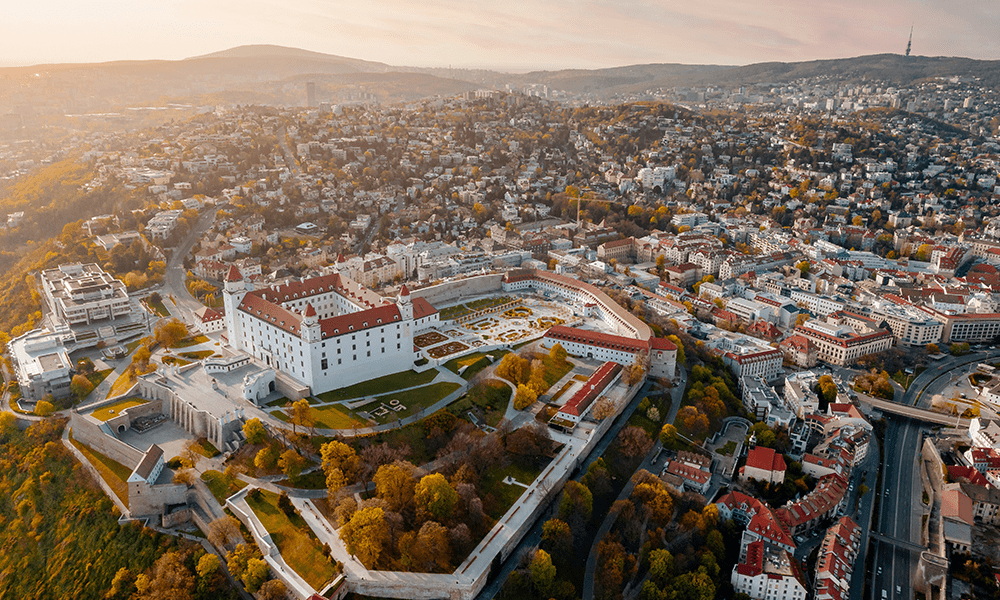
How Bratislava Is Turning Business into a Partner for Change

2025-12-09T12:08:36+01:00December 8th, 2025|

Author: Barabara Jarkiewicz Bratislava is redefining how cities and businesses can work together to tackle climate change. Through the Bratislava Mayor’s Climate Challenge, the Slovak capital is showing that real progress on emissions requires shared responsibility, trust and transparency.  “The city has a direct influence on only about 11% of emissions in Bratislava,” says Marián Zachar, project manager of the Bratislava Mayor’s Climate Challenge. “Companies, residents and private transport are responsible for about a third of the rest. The city wants to lead by example through its own investments and policies, but at the same [...]

‘We were lucky’: Twin City interview with Lund

2025-12-04T08:35:06+01:00December 4th, 2025|

The Swedish city of Lund has a unique perspective in the EU Cities Mission – how has it shaped its climate activities and learning? In a recent interview, Tommy Bengtsson and Juliet Leonette from the city’s climate team explain.  Of the many valuable opportunities available through the EU Cities Mission Cities, the chance to learn from peers in other cities is unique. Over 180 cities have already participated in peer-learning programmes through the Mission, collaborating not only with near neighbours but across more distant European borders too.   Lund, a mid-sized city on the southern tip of [...]

40 ambitious cities speeding to climate neutrality on Europe-wide peer-learning programme

2025-12-01T14:13:39+01:00December 1st, 2025|

PRESS RELEASE Over the next 12 months, 40 cities from 24 countries will work together on local climate action, joining a unique programme offered under the EU Cities Mission. Twenty-two new cities will bring the total number engaged through peer-learning programmes in the mission to more than 200. The Twinning Learning Programme is facilitated by NetZeroCities, which manages the EU Cities Mission platform, and will welcome the following cities as ‘Twin cities’ in the fourth cohort of the programme from 1 December 2025: Twin cities Paired with Mission cities Baerum (Norway) Reykjavik (Iceland) Cambridge (United Kingdom) 2nd district of Bucharest (Romania) [...]

Go to Top