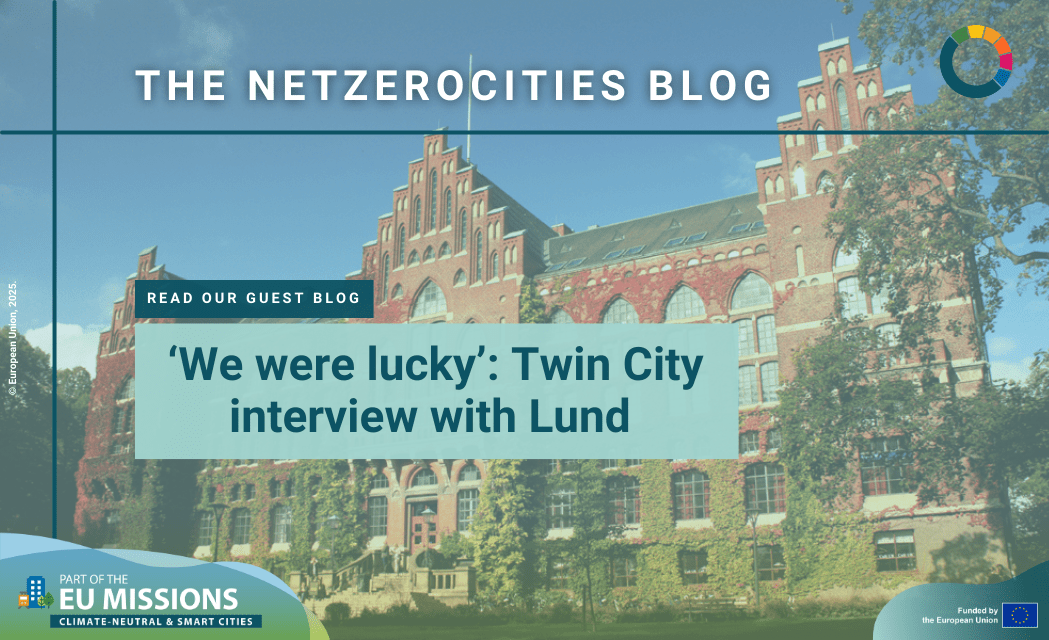
The Swedish city of Lund has a unique perspective in the EU Cities Mission – how has it shaped its climate activities and learning? In a recent interview, Tommy Bengtsson and Juliet Leonette from the city's climate team explain.
Of the many valuable opportunities available through the EU Cities Mission Cities, the chance to learn from peers in other cities is unique. Over 180 cities have already participated in peer-learning programmes through the Mission, collaborating not only with near neighbours but across more distant European borders too.
Lund, a mid-sized city on the southern tip of Sweden close to Malmö, is a notable cog in this system of knowledge sharing, as it circulates information for other ambitious cities to gather through the Mission's programmes and resources.
It has created a Climate City Contract and pursued a Pilot City project – both conditions of being a Mission City. But it has also been paired to 'follow' as a Twin City of another Pilot City – and been followed as a Pilot City itself.
"It's been a bit confusing for us as well with all the twins, but I'd say becoming a Mission City was aligned 100% with what we do," says Juliet Leonette from the city's climate transition team. "Lund has been working for decades on environmental issues."
Authority to deliver
The city has a strong understanding of how it needs to organise itself to meet its climate goals. Critically, support for those goals also comes from above.
"We have a very specific and a very clear mandate from the politicians. We have four municipal board goals and one is climate neutrality by 2030, so it's not anything we need to convince anyone [in the political leadership] about."
As one should expect, however, where there is progress, there is the need to communicate it effectively. More local engagement is required, particularly to engage the areas of the city responsible for the remainder of the emissions in the municipality. Only 8% of the emissions come from the administration.
"Lund has done tremendous things and last year we did a survey amongst the people of Lund, the citizens, and they actually don't know all the things we do. So there was a gap in communicating everything we do – they thought it was going worse than it actually is.
"So we have a communication strategy to think about because we haven't been bragging about what we want to do but not talking about what we actually do," says Leonette.
With some good fortune, and smart matchmaking from NetZeroCities' peer-learning experts, Lund has the opportunity to acquire some of the knowledge it needs on engagement and other themes too.
Building knowledge on shared ground
"We have been lucky, I think, with the connections because it's important if you want to have an exchange, there's potential to learn from both sides in a way," says Tommy Bengtsson, the manager of Lund's climate projects.
If the distance between cities in terms of the challenges they face or the stage of their progress is too great, then there might not be enough common ground to build on, he says.
"It's better if there's a mutual learning for everyone. We were lucky because [Lund, along with Westminster] were twinned with Leuven in the first cohort. We were both on the same page, we could learn from each other. It wasn't like Leuven was the only one sharing – it was more mutual."
As a Pilot City itself, they also have a new connection with a follower city in the UK who visited as part of the Twinning Learning Programme.
"And now we have Plymouth as a Twin for our Pilot City project, they were actually here. And they are supposed to be a follower to us but also they have a lot that's interesting for us too," says Bengtsson.
Home and away – learning in context
The Twinning Programme funds two visits of the twin city to the Pilot City and one reciprocal visit, but at the time of the interview, Lund hasn't yet made its own visit.
"We have talked a lot online and I think the learning goals we have towards them is not the same as they have to us. And they should be able to have different learning goals because we have our strengths, and weaknesses.
"For example, they're working with community engagement, they have a very nice web page that's very good at explaining what citizens can do or what matters and what everyone else is doing and it's not condescending in any the way, it's not shaming or something, it's just explaining […] So that's what we want to learn from them."
For Lund, what cities want to discuss with them is a common topic.
"Everyone's interested in learning about energy from us, from Sweden and Scandinavia, because we have worked with district heating since the 60s," Bengtsson says.
The twinning effect?
On a visit to fellow twin city Westminster, he was interested to discover that they had been developing community heat for some buildings in the 1960s, at the same time Sweden – now the sought-after experts – was building its heating networks.
"The difference was that they went over to gas and it was the same in the Netherlands and Belgium, Germany, all those countries. But if they hadn't done that, they would probably have been at the same level as we are [in community heat development]," he says.
This would have been a decision outside of a city's purview, but the possible alternative outcome Bengtsson suggests is worth pondering, as are the new futures being written from these novel collaborations.