Kozani is part of “a region in transition,” says the Greek city’s climate lead, as it plans for a future without the mining industry that until recently sustained it. Showing citizens the value of clean energy to their finances, as well as to the climate, is crucial – and finance experts from NetZeroCities’ Capital Hub are working closely with the city on the numbers.
Michail Kastanaras is “quite new to the struggle” that Kozani began a few years ago, he says, but he and his colleagues are now playing a special role within the local climate team.
“We are the binding glue, let’s say.”
Kastanaras joined the team in April 2025 after the city had reached the major milestones of submitting its Climate City Contract (CCC) and receiving a Mission Label.
As the manager now of the municipality’s climate activities under the EU Cities Mission – and implementing the projects outlined in its CCC – there are plenty of challenges outstanding for Kastanaras and his team.
Finding the finance with the Capital Hub
With the Mission Label, Kozani has been able to access assistance from the Capital Hub for its most important project – greening its district heating network.
Political support, planning, and finance are all an issue, but “if I had to prioritise one,” Kastanaras says, “it would be financing.”
Working alongside the Capital Hub, the municipality isn’t navigating unfamiliar terrain on its own, but it is nonetheless “dealing with a difficult situation.”
“We not only have a climate city contract to implement. We are a region in transition also and that makes things extremely hard for us,” says Kastanaras.
A model of a difficult transition
As well as trying to replace coal in its district heating network with natural gas and renewables, Kozani and the region face the effects from the closure of the coal mines themselves that fed both the network and the surrounding communities.
The power plants and mines have been a basic source of income and lost job or economic insecurity don’t make the case for local climate action easier.
“’We weren’t asked,’ that’s something that you hear a lot in the territory.
“That’s a central issue when you are trying to convince someone about climate issues and CO2 emissions mitigation.”
Connecting big problems to local action
And while news stories about extreme heat and wildfires in Greece are well known to citizens across Europe, these events haven’t necessarily translated into stronger local support for climate action.
The situation in Kozani – 700m above sea level in the highlands of Western Macedonia – is also particular. District heating costs for consumers have been rising in recent years, perhaps by as much as 50%, and people will heat their houses by burning what they can find.
When we spoke on the last day in April, the temperature there was just above freezing.
“We are dealing with survival issues sometimes,” says Kastanaras, and citizens aren’t thinking about the climate when trying to heat their home between October and April.
“You need to put in a lot of effort to convince them that they should also consider the environment as a major issue because it’s something that their children will deal with in a few years.
“The quick answer is, ‘I need to survive this winter, and I will see what will come in a few years from now.’”
The climate numbers game
Which makes the correct financial management of its projects all the more critical.
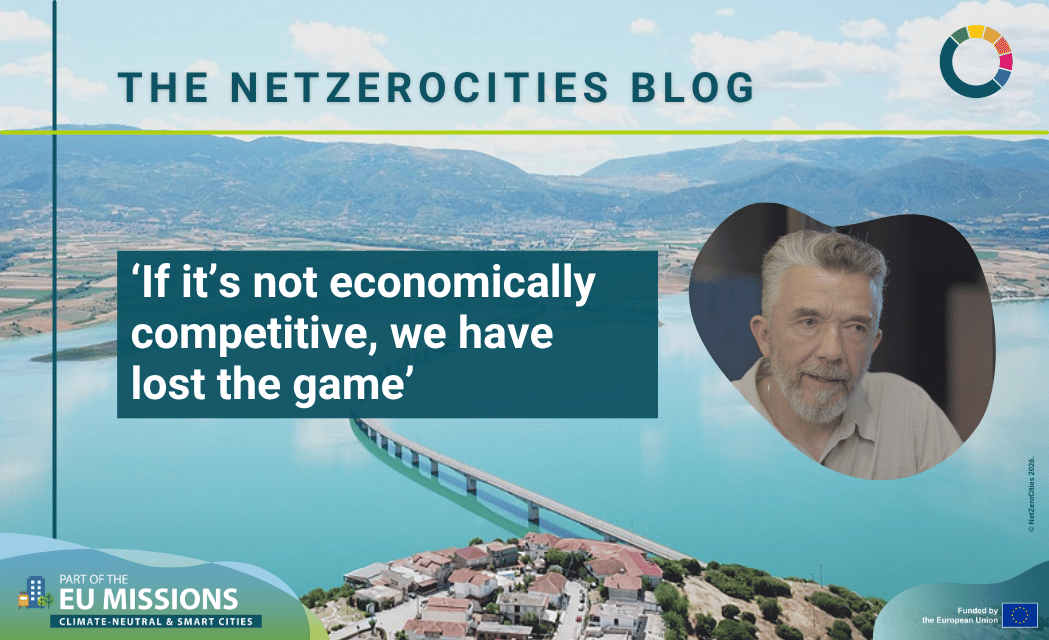
“You can show citizens that it would be environmentally useful, and we will mitigate CO2 emissions as the greening of the district heating is the flagship project of the climate city contract. But if it’s not economically competitive with other solutions, I believe we have lost the game.”
With the Capital Hub and the city’s advisors, the city is now creating a road map for transforming its district heating network. (The network owner aims for it to be powered by a minimum of 40% renewables by 2030, which Kastanaras believes is feasible.)
Through his access to this expertise over the last 12 months, Kastanaras has become “more aware and more confident about certain steps that we should take.”
“The formation of the team was something that came out of those discussions and that was not financial advice, but strategic, and advice about management of the transition team, and I’m very grateful for that help.”
Kozani participates in many workshops and meetings through the Mission, but of all the support,
“I believe that the Capital Hub is a valuable assistant,” he says.
“They are very patient with us. Very helpful, very understanding.”
‘A consuming project’
“Kozani is basically the first city that we’ve really been working closely with because they have this huge project, which is not just an energy project, it’s a social project,” says George Ioulianos, a finance specialist whose expertise and time is available to Kozani through the support of the Capital Hub.
Ioulianos is one more than a dozen consultants assigned by NetZeroCities to support a country or region, both for their financial expertise and as native speakers familiar with local regulations.
“The district heating and the lignite mines were the economic activity of the city, so we’re trying to approach this in collaboration with the city support groups, including on building a roadmap that doesn’t view this only as an energy project, but as a project that needs to engage stakeholders and needs to ensure that there is new economic activity. And that everything is, of course, done in a sustainable way.”
Doing things in a sustainable way will also apply to the teams working on the projects. There isn’t enough capacity in the teams to run them in parallel.
Other priorities are retrofitting works and mobility in the city, but these will have to take a back seat to the district heating network for the moment.
This is understandable as Kastanaras continues “the struggle” begun by his predecessors, but he responds modestly.
“It’s a consuming project,” he says.