A short-term implementation-focused programme for accelerated impact.
Leveraging Innovation and Financing Transformation Call
The Leveraging Innovation and Financing for Transformation (LIFT) call is now open with applications closing on 24 August 2026.
LIFT provides €2 million in funding for Mission cities to expand the Enabling City Transformation portfolio and address key barriers to climate neutrality through more innovative financing, governance, and systems-change interventions that can be scaled and replicated across Europe.
This is a short-term, implementation-focused programme that will run from 28 September to 6 November 2026. It represents a strategic reinvestment of unused resources from Pilot cities cohort 2 and 3 and Enabling City Transformation programmes to Mission cities that have technical and operational readiness for immediate implementation, allowing accelerated impact and potential for replicability.
INFORMATION WEBINARS
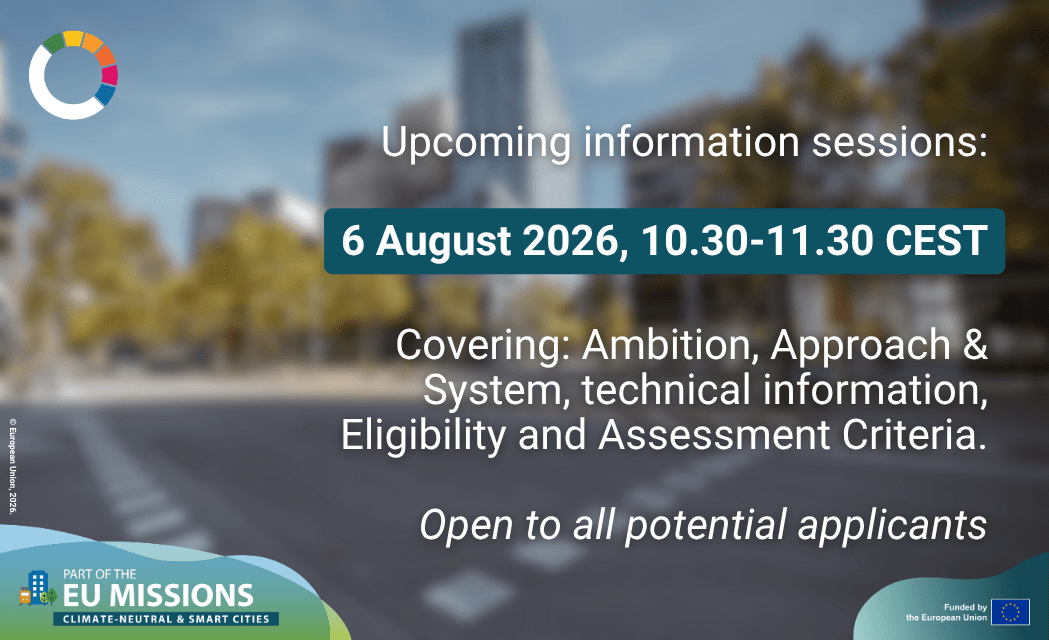
An Information Session took place on 6 August 2026, covering the following topics:
- Ambition, Approach & System
- Technical Information
- Eligibility and Assessment Criteria
TIMELINE
Leveraging Innovation and Financing Transformation Programme
The Leveraging Innovation and Financing for Transformation (LIFT) call is scheduled to open on 28 July 2026, with applications closing on 24 August 2026.
LIFT provides €2 million in funding for Mission cities to expand the Enabling City Transformation portfolio and address key barriers to climate neutrality through more innovative financing, governance, and systems-change interventions that can be scaled and replicated across Europe.
This is a short-term, implementation-focused programme that will run from 28 September to 6 November 2026. It represents a strategic reinvestment of unused resources from Pilot cities cohort 2 and 3 and Enabling City Transformation programmes to Mission cities that have technical and operational readiness for immediate implementation, allowing accelerated impact and potential for replicability.
28 July 2026 - 24 August 2026
Open Call – Leveraging Innovation and Financing for Transformation (LIFT)
11 September 2026
Decision communication
End of September 2026
Publication of Call outcomes
Up to 28 September 2026
Contracting
CALL DOCUMENTS
Call Guidelines
RESULTS
NetZeroCities has selected three European cities to implement innovative approaches under the LIFT programme. Bristol will establish a community energy accelerator to mobilise public, community and private investment in municipal renewable energy projects. Leuven will develop a blended municipal investment fund to finance climate action across social real estate, heat and the circular economy. Aarhus will deploy and test lightweight photovoltaic technologies on municipal buildings whose roofs cannot support conventional solar panels.
FREQUENTLY ASKED QUESTIONS
General Information
Once the LIFT Contacts list has been created during the refinement of selected proposals, any change to contacts can be requested only by the Lead contact through an email titled LIFT Contact update – [NAME OF THE LEAD CITY] to ect@netzerocities.eu
The programme lasts from 28 September 2026 to 06 November 2026 (cost eligibility will start the date of the outcome letter). Though the project is not extendible, however, we anticipate the work of cities to continue, in the context of cities’ wider transformation and decarbonisation efforts.
The overall budget availability is 2.000.000 EUR. The smallest envelope will be 500.000 EUR and the biggest 1.500.000 (also 1.000.000 is possible), regardless of the number of Mission cities included in the proposal but determined by the scope of the proposal.
Each work package in the proposal contains specific delivery milestones and deliverables and is assigned a lump sum. Funds are released strictly upon the completion of work packages and not as reimbursement of actual costs. Payments depend on what was achieved rather than how much was spent. That doesn’t mean that lump sums are not calculated: lump sums are evaluated against a detailed budget for accuracy and efficiency before award agreement signature.
Contracting
Given that the LIFT programme duration is exceptionally short, no formal contract amendments are planned or possible during this timeframe. The tight operational schedule leaves no administrative window to process amendments. However, smaller description changes and minor delivery delays do not require a formal contract amendment and can instead be addressed as standard project deviations directly within final reporting.
Organisations to be included in the consortium are, for example: research institutions, universities, SMEs, NGOs, associations, citizen groups. As long as the second organisation has a different legal name it can be added, including a partially municipality owned organisation. The consortium should include organisations so that impartial and objective execution of a project is not compromised by economic interests, political affinity, or personal ties. If public funds are funneled into a private or semi-private entity partially owned by a public office holder tied to the contracting authority, it violates rules against favoritism, misuse of public office, and financial irregularities. Regarding private companies, costs in the budget need to be justified against the specific task deliverables rather than corporate profit margins for the No-profit principle.
No, the budget will be evaluated only during proposal assessment. Once the budget of a selected proposal has been confirmed for accuracy and efficiency it won’t be included in the signed award agreement, but will be replaced by a table listing the work packages and the associated lump sums. Aplicants can expect their submitted budget to undergo adjustments by NetZeroCities before award agreement signature, during the refinement process.
Cost eligibility and financial guidance
Under LIFT CFS is not required. LIFT is a lump sum grant model, hence financial reporting does not contain reference to actual costs.
Ideally, the project work should be done by the beneficiaries and their partners, but if needed, they may rely on outside resources. Subcontracts concern the implementation of an action task as described in the work plan of Annex 1 (i.e the organisation of an event), while purchase of goods and services only covers activities that are necessary for the beneficiary to implement said task (i.e consumables, the event’s catering, translations or room booking). For further information, we invite you to consult HE AGA and eventually your NCP that can provide the most reliable and legally sound way to determine cost categories and eligibility of activities. As Climate KIC we administer the grant but recommend reaching out to NCP for specialised regulatory advice.
Please note that all beneficiaries need to follow their usual accounting practices, including the depreciation rules. In general, only the portion of costs directly attributable to the project and for the duration of the project can be depreciated and is eligible, including software. For more information please consult the Financial guidelines and the HE AGA.
The cost eligibility starts on the day of recept of the outcome letter (actually planned for the 11th September), the project start date (28th September) identifies the date the programme officially starts and by when the grant agreement needs to be signed. Cost eligibility runs until the offical project end date (6 November). The costs of reporting following the ending of the project are eligible as long as they’re included in a work package that ends before programme end.
Beneficiaries do not need to track or report actual costs, timesheets, or invoices. Funds are released strictly upon the successful completion of work packages and acceptance of deliverables. It is not possible to redirect money to funds for an indefinite future use, at the time of programme duration all funds destination needs to be know and rolled out.
All LIFT projects should only report activities that can be traced back to the project. In presence of activities financed also through other sources of funding it must be clear which tasks are financed thourgh the LIFT Programme. Costs funded through other sources should not be reported in the project. It is not possible to include activities that at the time of project start are already ongoing.
VAT is an eligible cost when not deductible. VAT deductions depend on the applicable National legislation, so each organisation participating in the NZC project should be aware of their VAT status. Invoicing has to follow the usual policies and practices of the organisation. Services can be bought externally, and the organisations have to follow their usual procedures (they also depend on the type of organisation: SMEs; Public Authorities). For more information, please consult the Financial Guidelines and the HE AGA.
All project budgets need to be drafted and reported in Euro (see application form). Applicants established in countries outside of Eurozone must use the conversion rates as published in the Official Journal of the European Community; or if not available, the monthly accounting rate established by the Commission and published on its website. Please note that the project beneficiaries fully carry the exchange rate risk as these costs are not eligible for reimbursement.
Once the lump sums per each work package have been identified, the lump sum amount will be paid after the completion and approval of the work package. No reimbursement is foreseen for partially completed work packages if not under extra-ordinary circumstances that were not know at the time of application submission and occurred at a later time.
Monitoring, Learning, and Evaluation (MEL)
Overall GHG emissions reductions is the mandatory KPI to be mentioned in the LIFT proposal. Using the recommended list of impact indicators provided as part of the impact framework, projects are requested to select standardised long term GHG impact indicators and cobenefit indicators along with any customised indicators proposed by the project. While most indicators on this list are recommended, it is mandatory for projects to select at least one standardised long term GHG impact indicator.
Considering the short duration of the programme, modifications to the indicators will be accepted only in occasional, out of the ordinary cirumstances.
Communication and Dissemination
If you’re unsure about branding or content of your NZC communications you may require assistence here: https://app.smartsheet.com/b/form/16396a127d6b4e1b8e5ba42aecf12d78
Reporting
Proposal narrative, deliverables listed as mandatory in the LIFT call guidelines and all reporting instead should be done in English. Additional deliverables identified by the applicant can be prepared in the local language as long as a high level summary is provided in English during reporting.
Timesheet are not requested during reporting, however we do recommend you keep them in your archives for auditing purposes for at least 5 years.
In the LIFT programme there is only one reporting period: Procurement & Resource summary report; Implementation and impact deliverable; MEL reporting (insight & outcomes, indicators reporting excel) shall be submitted on the reporting platform within 6 November 2026.
Work packages are reviewed and approved/rejected independently from each other, but based on the completion status of the contained milestones and deliverbales.
If you have questions, you can reach out to us via email!