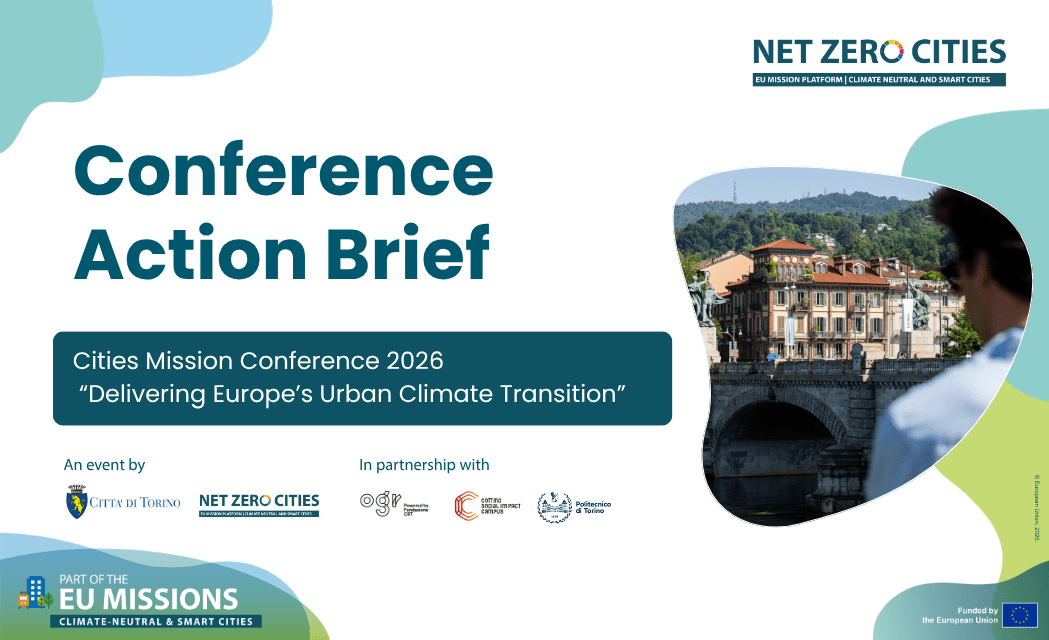
Over 100 European cities met this year in Torino to pursue a common goal of climate neutrality. Each city faces similar obstacles but is benefiting from shared solutions and learning through the Cities Mission. NetZeroCities' partners ICLEI Europe, with support from LGI and Climate KIC, have brought the key learning and actions from that major conference into one piece of essential reading.
Every city working towards climate neutrality runs into the same four challenges sooner or later:
- how to finance the transition,
- how to organise city hall internally to deliver it,
- how to shape conditions beyond its control, and
- how to prove what´s working and adjust the course.
Helpfully for Mission cities, Mission-minded cities and everyone supporting city climate transitions, essential and timely reading is available.
Following this year's Cities Mission conference, NetZeroCities has produced a brief offering up-to-date insights, ideas and practical suggestions from the cities tackling these sustainability challenges right now.
No city claims the challenges above are solved, but there's a shift underway. As Stefana Hoti, First Deputy Mayor of Malmö and host of the 2027 Cities Mission Conference said in Torino: "The main takeaway is not what we still lack — it is recognising how far the Mission has come."
Challenge one: financing the transition
Mission Cities need to mobilise hundreds of billions of euros over the coming years, but the projects they most want to deliver often don't make enough money on their own to attract private investors. Some are already tackling this.
Dijon set up a joint company with a private investor to roll out solar power and heating city-wide, while Bristol's 20-year City Leap deal has a private partner carrying the financial risk — over €500 million invested so far. Others, like Milan, Prato, Parma and Reggio Emilia, are bundling small projects into neighbourhood-scale packages via the Climate City Capital Hub.
As its Director, Delphine Queniart, put it: "The biggest misconception is that cities tend to think that capital follows good ideas first. In fact, investors look for clear governance, low execution risk and speed of deployment."
Explore these insights and more case studies under Track 1 – Innovative Finance.
Challenge two: organising city hall
One of the biggest obstacles to climate neutrality isn't technology but how city halls are organised and run. Climate work cuts across departments that were never designed to work together, and suggestions to overcome this range from cross-departmental delivery teams to treating scientists as genuine co-design partners.
Host city Torino shows what that looks like: with Politecnico di Torino, it built the CLICC platform linking strategy to live project data — proof research speeds delivery when embedded in decision-making, not consulted after the fact. Helsinki turned Kaivokatu, a street carrying 20,000 cars a day, into a green, car-free space, tackling emissions and adaptation in one move. Velenje runs a one-stop shop of neutral advisors, while in Lappeenranta, Nantes and Stavanger citizens act as co-designers, testing and evaluating ideas alongside city staff.
Explore these insights and more case studies under Track 2 – Deploying Solutions.
Challenge three: shaping conditions beyond our control
Even well-organised cities hit walls they didn’t build: national rules, market conditions, funding designed elsewhere. Torino‘s conference made the case for shaping those conditions rather than waiting for them to change, starting with procurement. Paris mobilises roughly €3 billion a year through it; Stockholm, with three partners, cut construction emissions by 19% at no extra cost simply by setting joint requirements in contracts. The national level matters too: Valencia called Spain’s CitiES 2030 platform “the most useful and impactful support we got from the Mission so far.” Working with industry helps too, starting from one simple discovery: cities and companies count carbon differently.
Explore these insights and more case studies under Track 3 – Strategic Engagement.
Challenge four: prove what's working and adjust the course
A Climate City Contract, like any transition strategy, is never "final". The advice from the 2026 conference was practical: don't wait for perfect data, start with what you have, and iterate. Nine cities have already done exactly that and reworked their original CCCs. Zaragoza for instance expanded its CCC from three focus areas to five after in the second version, folding economic modelling, participation and monitoring into one structure.
Cities are getting sharper at showing their working too: Mission city Malmö and Mission-minded city Bilbao each cut emissions well below baseline — around 50% and over 60% respectively, while Paris now cross-checks its inventory against atmospheric measurement. None of this happens on its own – it's the product of years of climate action, of which the Mission is one part.
Justice matters just as much: it must be designed in from the start, not bolted on. Bristol, for example, pairs an activist-drafted Just Transition Declaration with community-led climate and nature action plans, while Vitoria-Gasteiz treats its urban master plan itself as a justice instrument.
Explore these insights and more case studies under Track 4 – Mission Impact & CCC Iterations.
Finally, the action brief also includes insights from the 'city dives' – unique, interactive visits to neighbourhoods and projects – and the conference plenaries.
Where to start
Every section of the brief ends with a toolbox — resources to use now, "what to do next" lists, cities to learn from, places to plug in — so there's an obvious first step wherever you sit, and a peer who's already taken it.
We hope you enjoy exploring this unique resource and welcome any questions or feedback.