Background
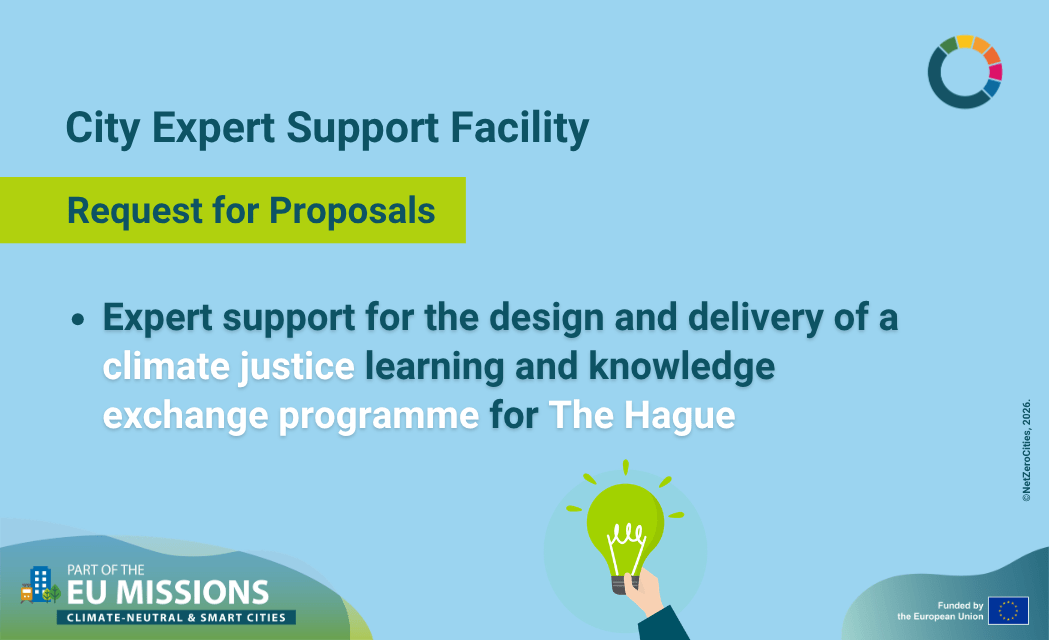
The Hague Climate Justice Lab [The Lab] is a two-year urban learning programme launched in February 2026, bringing together the Municipality of The Hague, Duurzame Den Haag, The Hague Humanity Hub, and Leiden University to research, test, and structurally integrate climate justice into the city’s governance, policy, and practice. The Lab operates as an action-learning programme designed to produce actionable outcomes for policy and practice, with interim insights designed to feed back into the programme and inform adjustments across three interacting tracks: (A) resident-centred learning, (B) cross-sector knowledge exchange, and (C) municipal policy innovation.
The Lab is funded by the Municipality of The Hague. Seed funding covers the minimum viable programme, including the core activities needed to run the Lab locally, including initial conversations and engagement with partners. As the Lab got underway, it became clear that a series of structured events with a clear methodology and documentation mechanism would not only produce better results locally, but create the conditions for the Lab’s approach to climate justice governance to be documented and made available to other cities. The CESF funds that additional layer, enabling the Lab to produce replicable methodologies, harvested knowledge on climate justice in practice, and an activated network of locally and internationally operating organisations that are active carriers of knowledge and advocacy on climate justice beyond The Hague. The Lab is designed not only to generate learning for The Hague, but to contribute to a growing body of practice on climate justice governance that Mission Cities can draw on and contribute to.
Current situation: The Lab is in its first year of operation. Resident engagement and policy work are actively underway. The CESF funds the specialist methodology, harvesting infrastructure, and knowledge products needed to make the Lab’s learnings travel beyond The Hague.
Key stakeholders the supplier will work with:
- Municipality of The Hague: Mission city, client
- Internationally-operating organisations at the intersection of climate, peace, and justice, based in or operating from The Hague
- Community organisations, resident initiatives, and civil society actors in The Hague
- Policymakers and municipal staff participating in the learning events
Key risks and challenges:
- The Lab is an action-learning programme. The contractual scope and deliverables remain fixed. The supplier’s facilitation techniques and stakeholder engagement approaches may be adapted during implementation in response to emerging learning.
- Ensuring equal participation across very different actor backgrounds: residents, international organisations, policymakers, requires specialist socially-inclusive facilitation expertise
- Climate justice work operates in a politically sensitive context. The Lab operates with awareness of this and prioritises what is achievable within current conditions. The supplier should approach stakeholder engagement with discretion and adaptability
- The assignment timeline is fixed, with preparatory work required before Fall 2026 when the first Learning Lab is scheduled
Key externalities:
- The Lab is designed as a first 2-year phase with ambition to continue for 2 more years afterwards. The supplier should support the Lab in building a credible foundation for future development
- Outreach to Mission Cities including Rotterdam, Bristol, and Dortmund, and cities beyond the Mission working on similar agendas, is underway to explore potential to connect into the process.
Scope
Climate KIC, acting on behalf of NetZeroCities, is requesting proposals for specialist expert support to The Hague’s Climate Justice Lab across three components, to be delivered between the end of September 2026 and December 2027.
Component 1 — Stakeholder Mapping & Ecosystem Development
Estimated effort: ~15 working days
The assignment covers development and activation of two distinct but interconnected networks: locally-rooted community organisations and resident representatives working on climate justice in The Hague, and internationally-operating organisations at the intersection of climate, peace, and justice. It includes:
- deepening the existing stakeholder mapping through targeted research and documentation;
- identifying organisations’ relevance, potential contribution and participation requirements;
- undertaking one-to-one engagement and relationship-building with selected organisations;
- preparing and onboarding stakeholders for meaningful participation in the Climate Justice Lab;
- designing a governance framework for the emerging ecosystem, including roles, structures and operating conditions; and
- producing a documented ecosystem map and governance framework that can support the network beyond the CESF period.
The ecosystem mapping is expected to cover approximately 10-15 local organisations and resident representatives, and 15-20 internationally-operating organisations. Each will require direct relationship-building and preparation for meaningful participation in the Lab.
Engagement with civil servants and municipal staff will be coordinated by the Municipality of The Hague, and engagement with Mission Cities will be coordinated by NetZeroCities — neither is part of the supplier’s scope.
Component 2 — Climate Justice Learning Labs
Estimated effort: ~30 working days (based on 4 events)
Design and delivery of four structured cross-sector learning events in The Hague, conducted in Dutch and English depending on participants and session context, bringing together diverse actors — residents, policymakers, civil society, and international organisations — with a socially-inclusive methodology, producing harvested knowledge to inform ecosystem development and climate policy, and to serve as a learning resource for Mission Cities working on similar agendas.
The assignment covers the full delivery cycle across four events over 12 months, including:
- design of the overall learning journey;
- preparation and adaptation of each event;
- Identification, outreach, and onboarding of participants to support balanced and inclusive participation;
- design and facilitation of each session;
- development of knowledge-harvesting tools;
- structured synthesis of insights following each event;
- reflection and iterative refinement of the methodology between events; and
- production of reusable learning outputs for Mission cities.
Each Learning Lab is expected to bring together between 24 and 60 participants, running between 2 to 6 hours per session, depending on the proposed session design.
Where input from Mission cities would be relevant to the topic and format of a particular session, the event design should be sufficiently flexible to accommodate an appropriate form of participation. Any such participation will be coordinated by NetZeroCities and will not entail recruitment, travel or logistical responsibilities for the supplier.
NetZeroCities will provide limited strategic input during the initial design phase and at agreed review points during the assignment. The selected supplier will retain responsibility for the design, preparation, facilitation, knowledge harvesting, synthesis and delivery of all outputs.
Component 3 — Learning Dissemination Product
Total estimated effort: ~16 working days
Synthesizing the methodology, harvested knowledge and learnings from across the Climate Justice Lab into a transferable framework or methodology that can be adapted by other cities. The assignment includes:
- Synthesis of insights and lessons generated through planning, delivery and review of Labs;
- Development of a replicable and adaptable framework or methodology for application by other cities, as appropriate;
- Translation of technical and methodological insights into accessible formats for different audiences;
- Design and production of a publicly accessible knowledge product designed for replication by other cities, in a format proposed by the supplier based on the learnings generated through the assignment; and
- Preparation of digital outputs suitable for dissemination through Mission Cities and wider city networks (outputs may be suitable for printing, but this budget should not envision print runs).
The selected supplier will coordinate with NetZeroCities to ensure that outputs are suitable for dissemination beyond The Hague.
The proposal should consider the following:
- The Lab is an action-learning programme — the proposed methodology may remain sufficiently flexible to adapt facilitation techniques or stakeholder engagement approaches during implementation, without implying changes to the agreed scope or deliverables.
- Equal participation across diverse actor backgrounds is central to the Lab’s design — the proposal must demonstrate specialist expertise in socially-inclusive facilitation
- Dutch language competency is required for community and resident engagement activities
At the start of the assignment, the selected supplier will be expected to participate in a baseline briefing with NetZeroCities and the city to establish a shared understanding of the programme context and strategic approach. Where relevant, NetZeroCities will share learnings from other cities working on similar agendas to inform the supplier’s approach — this does not require additional sessions or formal outputs from the supplier. NetZeroCities experts are resourced separately and do not need to be represented in the financial offer.
For clarity, the following services are specifically “Out of Scope”: Venue, catering and logistics for events.
Timeline and additional information
Interested parties are invited to submit their proposals by 09 September 2026 (23:59 CEST Time) to Luisa Carretti and Mateusz Hoffman [CESF@netzerocities.eu]. Proposals should include and address all specific requirements related to the request which can be found below.