How to Participate?
The survey is web based and is available for completion and submission here.
The completed form with the replies must be submitted through the platform no later than 3 September 2026, 17:00 CEST. In case of technical problems with the submission, the form can be downloaded and sent by email to (cesf@netzerocities.eu) by the deadline. For any clarifications on the survey, please do not hesitate to contact by writing to cesf@netzerocities.eu by 24 August 2026. Questions will be collated and added to the website.
Scope
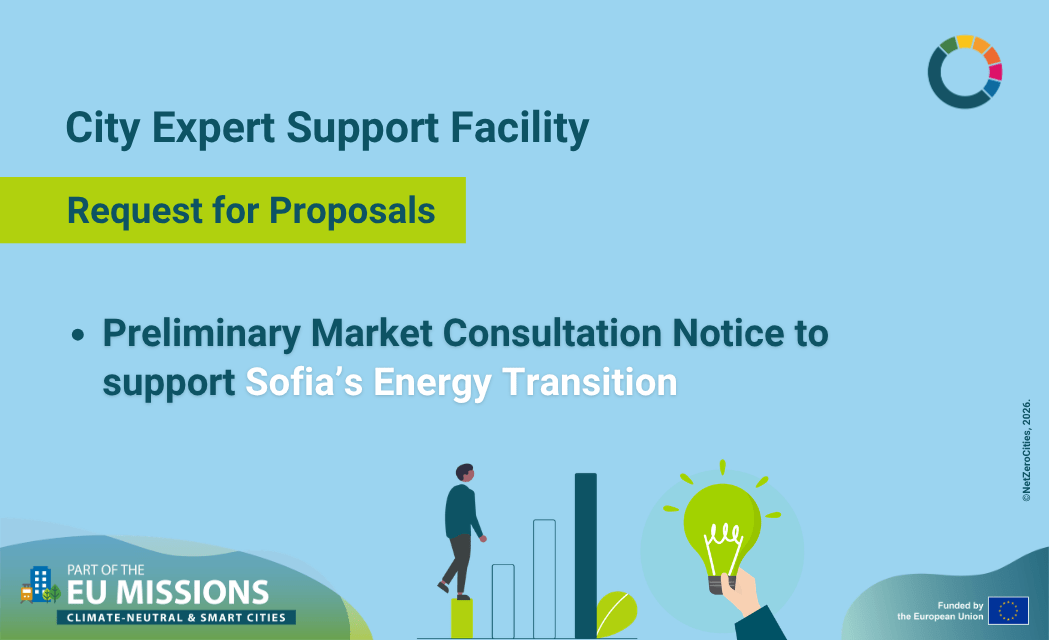
The overall objective of the expected assignment is to validate and assess the feasibility of the Positive Energy District (PED) strategic concept developed for the city of Sofia in Bulgaria, and prepare an implementation roadmap.
A Positive Energy District (PED) is an urban area that, on an annual basis, produces more renewable energy than it consumes, achieved through the integrated planning of buildings, energy infrastructure, mobility, and local governance. In Sofia, the PED initiative is being developed as a practical pathway to support the city’s climate-neutrality goals, with a particular focus on low-carbon and innovative district heating and cooling solutions.
As Sofia moves from exploration toward implementation, dedicated local expertise is anticipated to refine priority PED opportunities, assess governance and delivery models, identify funding and investment pathways, support stakeholder engagement, and develop a practical roadmap for implementation aligned with the city’s climate and energy objectives.
To achieve the above objectives, below activities are expected to be undertaken:
Part A: Validation and Assessment of PED
- Review the PED strategic concept developed through the NZC support process and assess its alignment with Sofia’s local conditions, priorities, and implementation realities.
- Assess the feasibility of proposed energy measures (e.g. renewable energy installations, energy efficiency retrofits, smart grid elements, geothermal, district heating, new heating and cooling solutions) within the Sofia context.
- Assess the applicability of the proposed PED approach within Sofia’s institutional, regulatory, financial, and political environment.
- Assess stakeholder readiness, institutional capacity, and implementation & decision-making conditions relevant to priority PED opportunities.
- Identify governance, coordination and delivery considerations that may influence implementation.
- Assess alignment with relevant Climate City Contract commitments, SECAP measures, district heating transition priorities, and urban regeneration objectives.
- Identify gaps, inconsistencies, risks, and key dependencies that may affect implementation, including technical, legal, financial, governance, and social dimensions.
- Identify opportunities to strengthen implementation readiness, stakeholder alignment, and investment attractiveness.
- Provide written feedback and recommendations to Sofia and the NZC team to strengthen implementation pathways and local applicability.
Part B: Implementation Roadmap for PED
- Develop a strategy and deliberate, detailed roadmap for the PED project concept, covering the period from district prioritisation through feasibility assessment and early implementation phases, including identification of explicit City decision points along with the sequence of work.
- Define concrete actions, responsibilities, sequencing, decision points, and milestones, considering local procurement rules, permitting processes, regulatory requirements, and financing mechanisms available in the Bulgarian context.
- Assess and recommend governance arrangements, stakeholder roles, coordination mechanisms, delivery models, and funding pathways to advance priority PED opportunities toward feasibility and implementation.
- Identify key barriers, risks, dependencies, and enabling conditions, and prepare a risk matrix with recommended mitigation measures.
- Identify near-term opportunities and quick wins that can build momentum, strengthen stakeholder confidence, and support future investment readiness.
- Align the roadmap with relevant municipal plans and strategies, including the Climate City Contract, SECAP, district heating transition priorities, and available national and European funding and technical assistance opportunities.
- Recommend next steps such as future feasibility studies, project development activities, partnerships, and implementation support required to advance priority opportunities
Timeline and additional information
Interested parties are invited to submit their proposals by 03 September 2026 (17:00 CEST Time) to [CESF@netzerocities.eu]. Proposals should include and address all specific requirements related to the request which can be found below.