
Cities are trying to rapidly reduce their greenhouse gas emissions and reach net zero, but why ‘net’ zero? This is where negative emissions come in. Paul Barton from NetZeroCities’ partner ICLEI Europe explains how critical these are for cities’ climate neutrality goals.
A less considered part of the terms “net zero” and “climate neutral” is that they imply that some carbon emissions can’t be mitigated by 2030. These leftover or “residual” emissions therefore need to be cancelled out through actions that remove carbon from the atmosphere.
Why do cities need negative emissions?
The removal and storage of greenhouse gases are often called negative emissions. That’s how a city gets to net zero: by reducing all the emissions it possibly can and then removing the equivalent of its leftover emissions from the atmosphere.
Carbon dioxide removal (CDR) actions are much more than an accounting trick to meet net zero targets – they are a crucial part of keeping global temperatures at a livable level.
According to the IPCC, negative emissions will be needed at an order of hundreds to thousands of gigatons of carbon dioxide removal, even in best-case scenarios for limiting warming. Mission Cities are taking the lead on exploring carbon removals at the urban scale.
In what is still a relatively new field, this is hugely impactful. (For a detailed look at what strategies cities have included in their Climate City Contracts, check out CCC Highlights on the topic.)
Types of carbon removal
Broadly speaking, there are two main ways of achieving negative emissions:
- by enhancing natural processes that remove carbon, or
- by using technology to capture greenhouse gases from the atmosphere and store them elsewhere (e.g. underground).
Any reservoir where greenhouse gases can be stored are referred to as carbon sinks. The team at the European Commission’s Joint Research Centre supporting Mission Cities has published guidance for negative emissions strategies for cities, (as well as a summary for decision makers) which goes into detail on CDR methods, carbon accounting, and conceptual frameworks, with a specific focus on the relevance and application for cities.
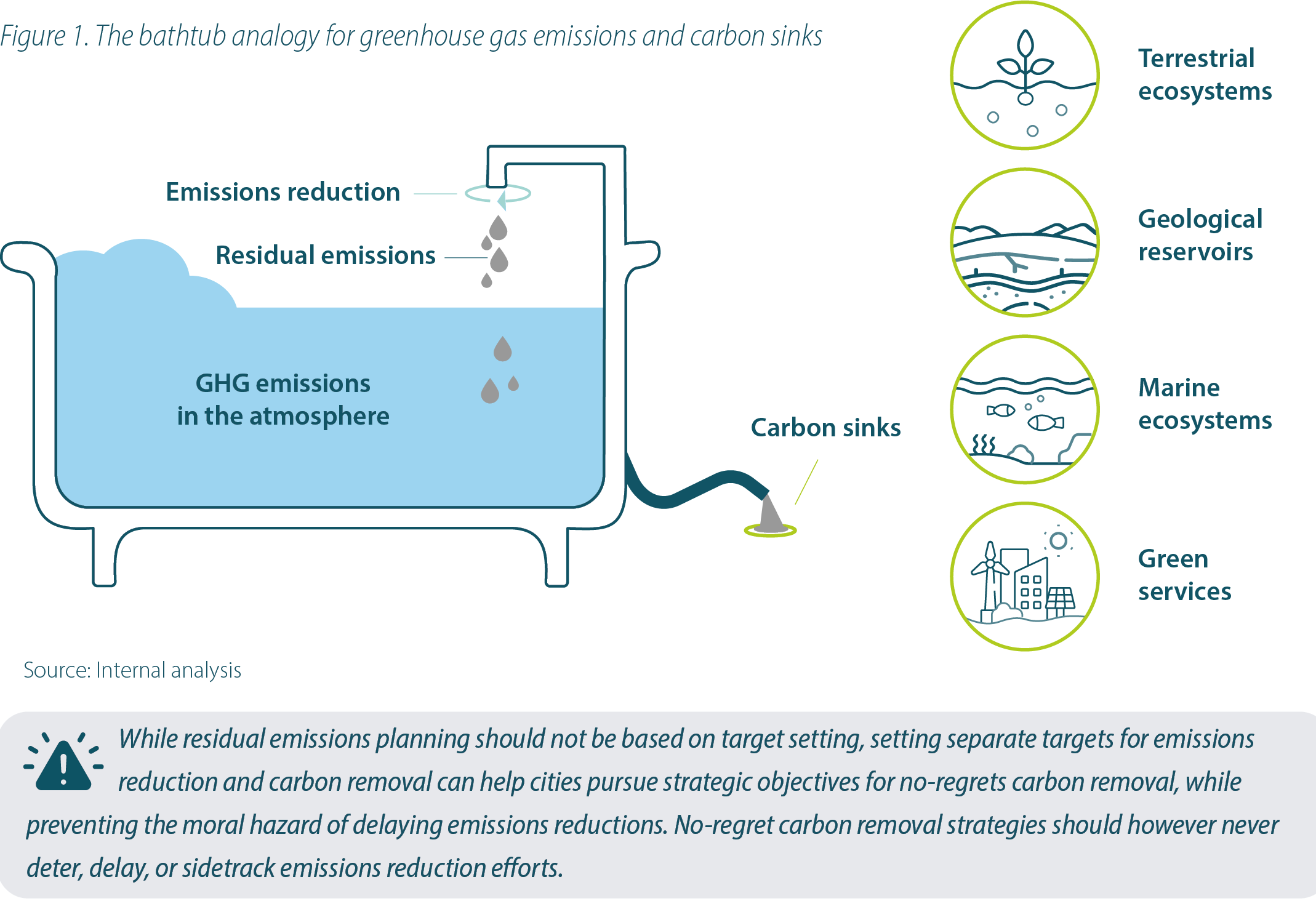
1. Negative emissions through ‘natural sinks’
Achieving negative emissions through forests, trees, and soils is a well-known approach for removing carbon. This makes sense given the simplicity of the core process (plants absorb carbon when they grow) and the variety of co-benefits associated with trees and other urban greening measures.
However, the accounting of natural sinks can be complicated. A forest’s carbon absorption capacity is very dependent on management practices and is vulnerable to becoming a carbon emitter through degradation or fire. The same goes for any individual tree; it needs to stay healthy to result in negative emissions. Good management is key.
The focus on forests and trees is due to their long lifespans and ability to continue absorbing carbon throughout that life (so planting grassy areas or flowers in urban parks will not merit the same attention when it comes to being a carbon sink).
Other natural sinks can be enhanced through restoring soils and wetlands within the city boundary.
2. Negative emissions through ‘technological sinks’
This category of sink is less established but still has significant potential and is generally considered to achieve more permanent removal of carbon.
Bio Energy with Carbon Capture and Storage (BECCS) and Direct Air Capture with Carbon Storage (DACCS) both involve capturing carbon and sequestering (capturing and storing) it through technological means, usually into a permanent geological formation like oil and gas fields.
BECCS works because it prevents the carbon plants captured by growing from being re-released when used as a biofuel. DACCS uses big, expensive machines to pull greenhouse gases directly from the air, so its energy source needs to be very low carbon in order to be a net carbon negative. It is important to note that similar carbon capture and storage combined with fossil fuel plants can be a useful way to avoid emissions, but they can’t count for negative emissions because no carbon was removed from the atmosphere.
More types of carbon removal
Another carbon sink option, biochar, is being researched faster than that of any other CDR method. Normally, plants decompose, releasing the carbon they absorbed during their lifetimes. However, with a process called pyrolysis, we can convert them into a stable, solid piece of carbon called biochar, which also has many co-benefits for healthy soils.
There are many other carbon removal options available, and some that haven’t ever been tried at scale but that Mission Cities could help pioneer. These include enhanced weathering, ocean alkalinity enhancement, and ocean fertilisation. Below is a graphic from the IPCC to help make sense of them all.
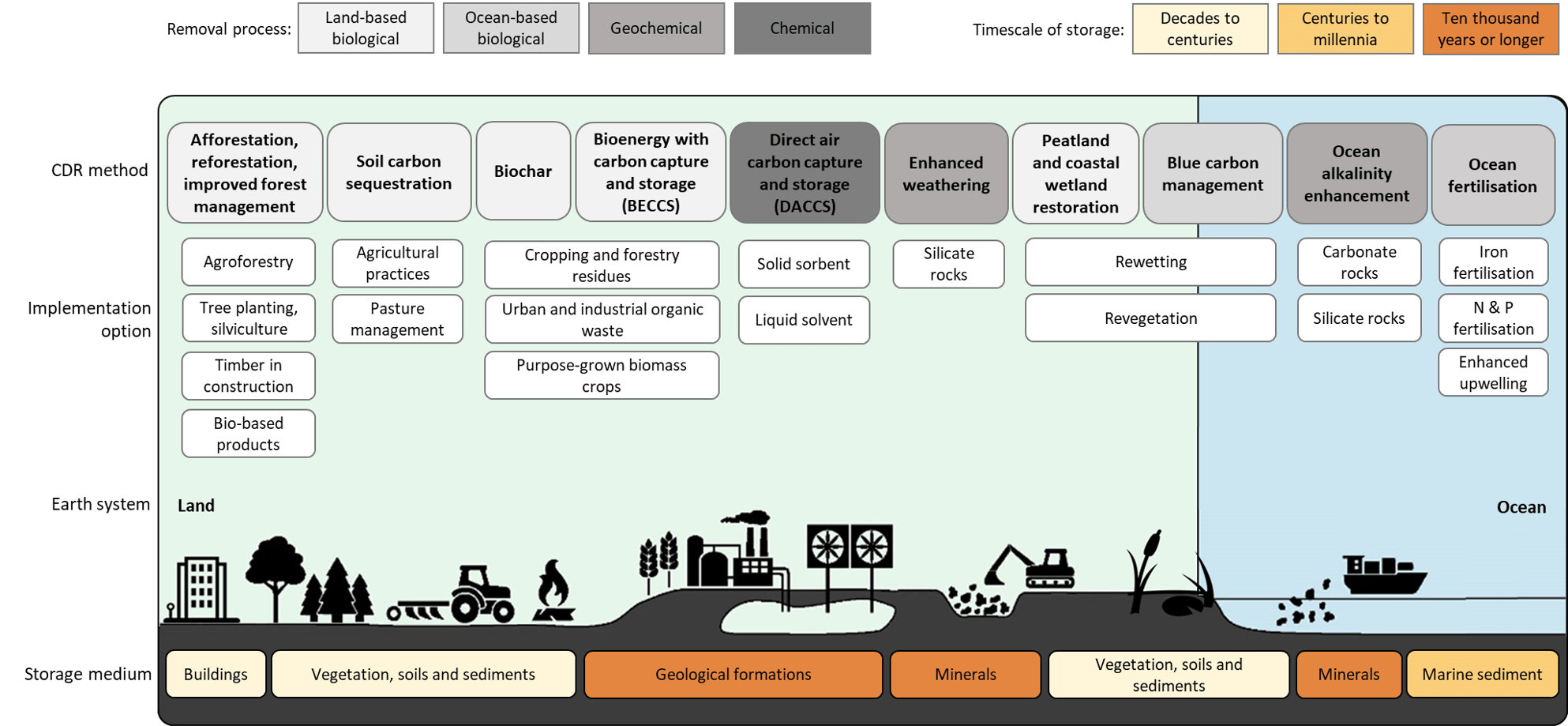
Carbon dioxide removal taxonomy. Methods are categorised based on removal process (grey shades) and storage medium (for which timescales of storage are given, yellow/brown shades). Main implementation options are included for each CDR method. Source: https://www.ipcc.ch/report/ar6/wg3/chapter/chapter-12/
Despite the necessity and importance of negative emissions for achieving carbon neutrality, the complications and risks for CDR activities are many and it is important to remember that the number one priority is always reducing emissions at the source!