
Author: Barbara Jarkiewicz
Every day, cities generate extraordinary amounts of information. Buildings consume energy. Buses move through neighbourhoods. Heat networks respond to changing demand. For years, much of this information existed in separate systems, making it difficult to understand how one decision affected another. Today, cities are beginning to connect those pieces through an invisible tissue of digitalisation.
Digital technologies are helping cities reveal hidden patterns, model and test pathways before investment, and monitor whether their climate strategies are effective.
“Climate change doesn’t respect sectoral boundaries. Heating decisions shift electricity demand, renovation choices shape affordability and public health, and transport is tied to air quality and public space. Most of this sits in departments operating under separate mandates, without a shared view of how their decisions interact, so policy made in one can undo work done in another without anyone noticing until it’s too late. Digitalisation is one of the few tools that can make those dependencies visible before the damage is done,” said Joanna Kiernicka-Allavena, Deputy Director of NetZeroCities.
European cities are already finding solutions to these challenges through NetZeroCities. Some are developing digital twins, virtual models used to test ideas before implementation. Others are creating data dashboards or new applications that bring together information from across municipal departments. While each city is responding to its own challenges, together these initiatives point to a broader shift: digital capability is becoming a climate necessity.
What if cities could test the future first?
In Lappeenranta, Finland, the district heating system, which supplies heat to buildings across the city, is shaped by information flowing from buildings, energy infrastructure and external conditions. As part of the city’s Beyond EE pilot activity, they created a data-driven platform that optimises district heating and monitors building energy, demand response and virtual power plant solutions. This helps make energy management more efficient, reduces fossil fuel use and keeps energy services reliable.
Digital twins extend this logic to whole neighbourhoods and cities. By combining data, simulations and visualisations, they allow planners to explore the potential effects of an intervention beforehand. For example, road closures can be assessed for their impact on noise or air quality. Building strategies can be compared by balancing construction-related emissions against future energy savings. Problems can be identified while they remain inside a model rather than after concrete has been poured or public funds committed.
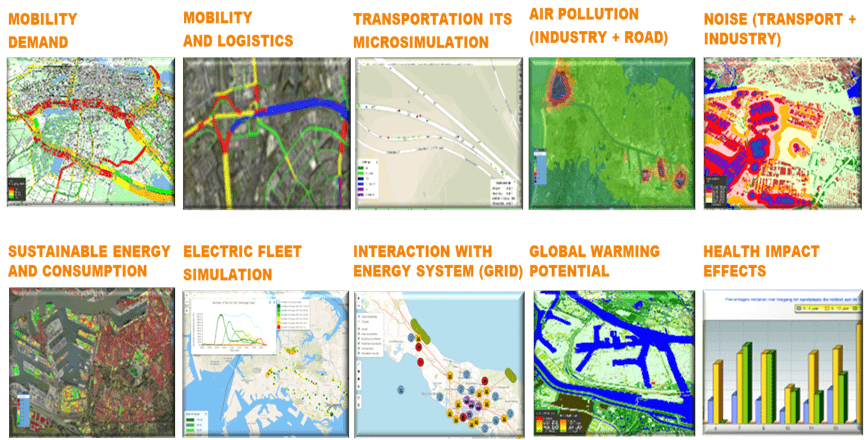
Examples of different ways to simulate and measure impact with Urban Strategy (TNO)
In the Greek municipality of Kozani, through the NEUTRON pilot project, engineers developed a Digital Twin to model the local district heating network. This advanced tool allows the municipality to test different operating scenarios and evaluate system efficiency before committing to permanent physical infrastructure changes.
Cluj-Napoca in Romania created a Climate Neutrality Digital Twin to model future scenarios for its high-density housing areas. It collects real-time data on heating, water, and energy consumption, enabling simulations that inform future projects and help residents visualise the impact of sustainable choices. For example, planners can simulate how different neighbourhood interventions, from building renovations to mobility measures, would perform before committing public resources to them.
The value is practical. Urban transformation requires decisions under uncertainty, often involving investments that will shape emissions for decades. A city that can model different pathways is better placed to understand trade-offs, detect unintended consequences and compare options that may deliver similar outcomes with different costs.
Translating data into decisions
Having better data and visibility into how a city works doesn’t automatically change anything. Data becomes useful only when it influences priorities, investments and day-to-day operations.
Cities’ climate dashboards make that possible. By translating real-time and historical data on emissions, traffic, road safety, energy demand, air quality and noise into maps, charts and indicators, they offer a comprehensive overview of current conditions and changes over time. This helps cities update their strategies accordingly.
Munich, Dortmund and Heidelberg are taking this further through Climate City Dash 2.0. By creating a , these cities work together to improve emissions inventories, scenario modelling and climate action catalogues. The digital work is paired with stakeholder engagement with businesses, civil society and researchers, so the platform supports the co-creation of climate action portfolios.
Madrid offers another model. Research linked to its Climate City Contract – the roadmap the city has committed to for reaching climate neutrality – guided the development of a digital portfolio tool to map relationships between projects, actors and change levers. The tool makes collaboration patterns, gaps and potential opportunities visible in real time, helping the city look beyond a collection of individual initiatives and understand how they function as a wider decarbonisation portfolio.
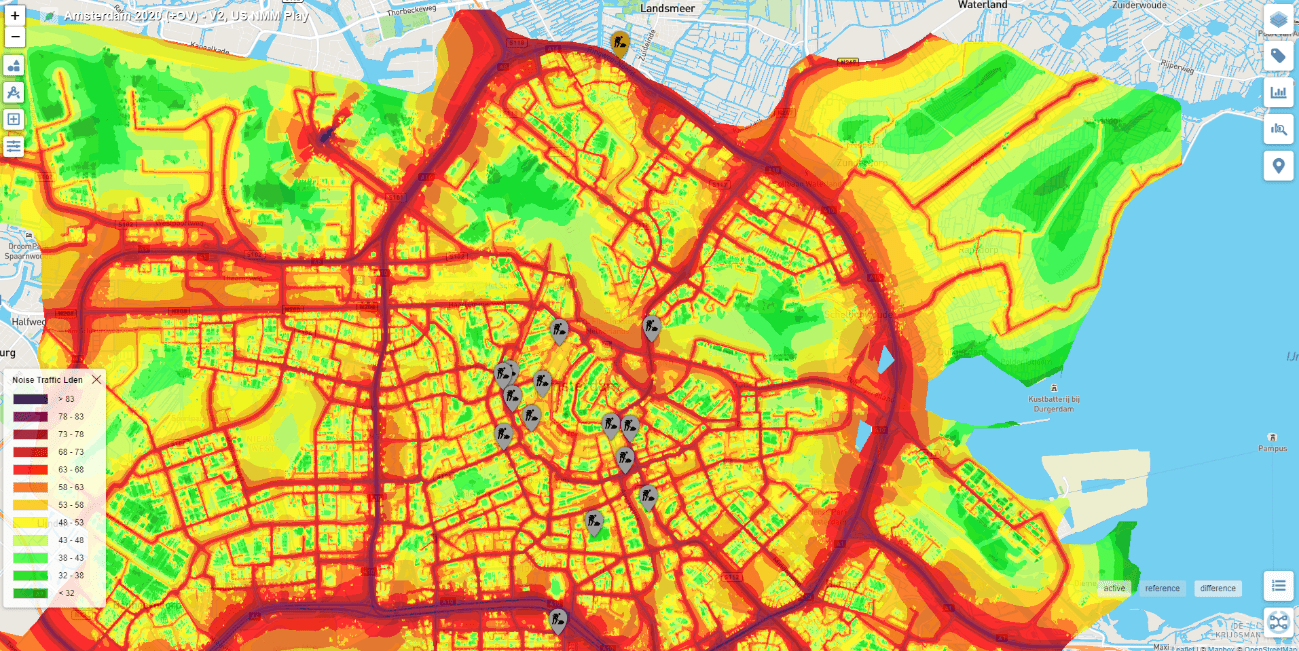
Example of Inspecting noise levels in Amsterdam using a dashboard (source: TNO)
These approaches signal a significant shift in municipal practice. Traditional climate plans often present actions as separate lines in a spreadsheet: renovate buildings, expand public transport, install renewables. A portfolio view asks different questions instead. Which actions depend on or are related to one another? Which organisations need to collaborate? Where is effort concentrated, and where are important gaps being missed?
The result is a more adaptive form of governance. Plans become less static because cities can use new information to adjust their course rather than waiting for the next formal strategy cycle.
Making citizens part of the system
The same technologies that help city administrations understand their infrastructure can also empower residents to act on climate. And these digital tools are proving essential for encouraging sustainable consumer behaviour and fostering active civic participation.
Porto’s WAKE UP! digital application is built on a key observation: only around 5% of the city’s emissions are directly under municipal control, while some 40% come from mobility and transport habits and 50% from energy use in buildings, putting the biggest levers for change in residents’ hands. The app integrates personalised citizen data on mobility, energy, water, and waste, providing a portrait of their environmental footprint. Gamified challenges and rewards encourage people to make their daily habits more climate-friendly, while allowing the city to assess which approaches work. This makes digital engagement more reciprocal: a resident can see how they contribute to a wider climate impact, while the city gains a clearer picture of behavioural change.
In Istanbul, the city deployed the GreenIST energy monitoring application to support its urban transformation plan. The application provides households with real-time energy tracking and personalised AI-driven savings tips. Apartments using the app as part of the pilot achieved verified reductions of 16.1 percent in combined energy use.
Citizen participation platforms can support many degrees of involvement, from access to information and consultation to participatory budgeting and citizen-led initiatives. This approach is visible, for example, in Madrid’s Decide, Helsinki’s participatory budgeting or citizen-sensing projects in Bristol and Brussels.
Digital tools cannot replace political choices or high-quality public services. An app cannot compensate for an unreliable bus route, nor can a dashboard resolve distrust. They can, however, make participation more continuous, decisions better informed and the impact of collective action easier to see.
Breaking down digital silos
The least visible part of digitalisation may prove the most important. Cities often rely on legacy systems developed by different departments, utilities and contractors. Building data may not connect with energy planning. Transport platforms may use different formats from environmental monitoring tools. Information gathered for one project can remain inaccessible to another. Without interoperability, cities risk replacing administrative silos with digital ones.
The Polish NEEST initiative illustrates both the challenge and the opportunity. Kraków and four Polish partner cities are working together to address emissions from the built environment through a shared digital tool. Their starting point includes familiar barriers: inconsistent building data, limited capacity to estimate the costs and effects of renovation, fragmented responsibilities and difficulties securing public support for change.
The collaboration is intended to help cities test approaches collectively rather than develop isolated solutions in competition with one another. Kraków has emphasised the value of sharing both successful and unsuccessful experiences, allowing participating cities to replicate what works and avoid repeating each other’s mistakes.
An engine that powers many vehicles
The projects emerging through NetZeroCities address different challenges. “No digital solution can simply be copied from one city to another. Governance, capacity, public trust and infrastructure vary too widely for that. What transfers is the method, not the tool: the way an approach is tested, the standards used, the lessons learned in making it work. Digitalisation’s real value here is giving cities a shared way to learn from each other’s decisions,” said Kiernicka-Allavena.
Digitalisation is becoming more than another strand of urban policy. Technology can help public authorities, businesses, utilities and residents make thousands of decisions with greater knowledge and coherence. In a transition defined by complexity, that ability to connect may prove indispensable.