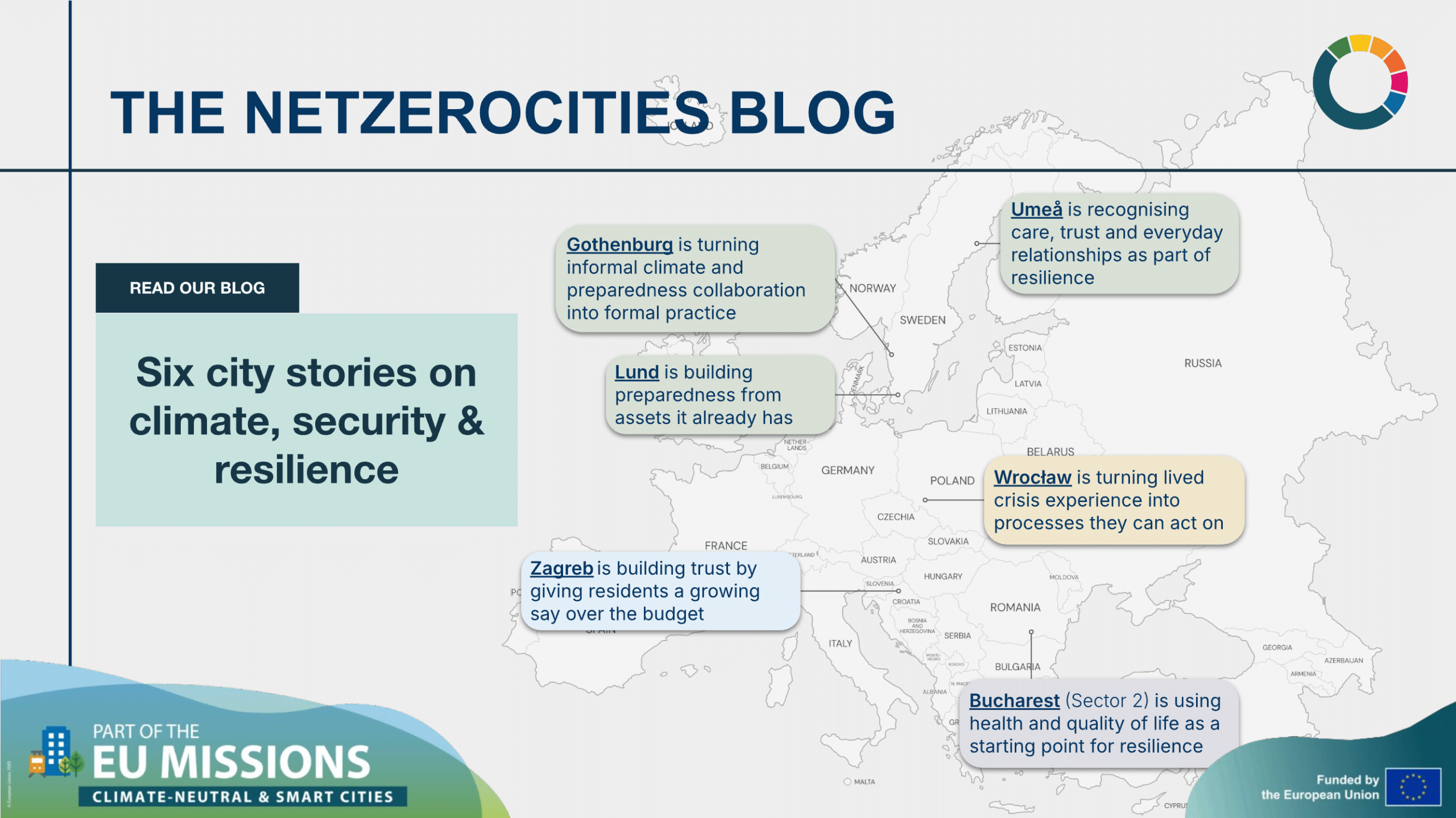
How are cities thinking about becoming more resilient through their local climate work? And what are the advantages and challenges of doing so? In interviews with Lund, Umeå, Gothenburg, Wrocław, Zagreb and Bucharest Sector 2, NetZeroCities partners Dark Matter Labs asked these questions. They share some of their findings and a link to more below.
What if the work your city does on climate is also how it prepares for disruption? Across these six very different cities, below are four patterns that stood out from our conversations.
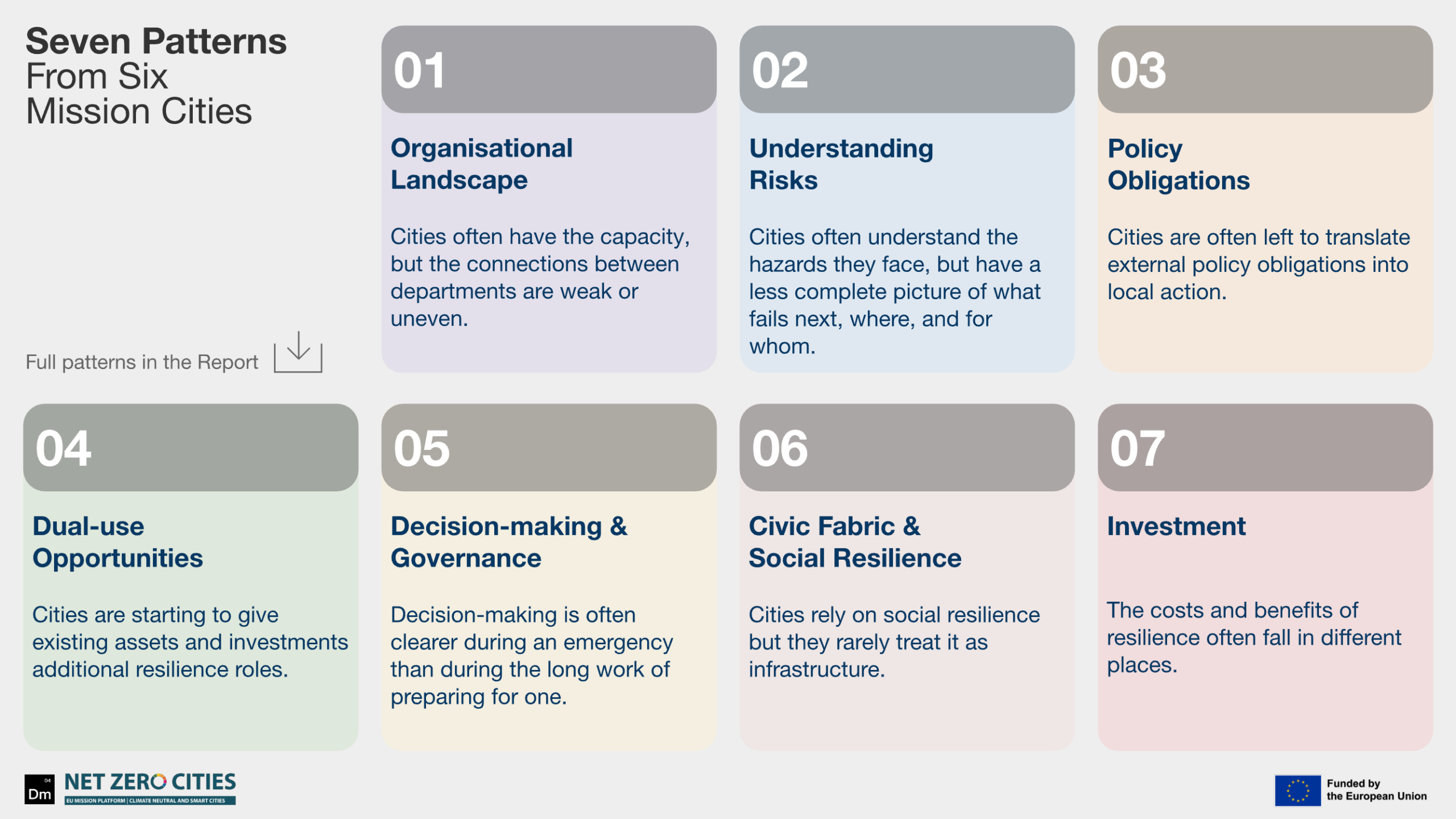
1. Existing assets are taking on second roles
Schools, sports halls, museums, pools and shopping centres are being used, or considered, as shelters, cooling spaces and support points. But dual use tends to stop at single buildings, while many of the assets that cities depend on (infrastructure for energy, water, flood defences) sit outside municipal control.
“Like probably everyone in Poland, we are looking closely at multipurpose facilities,” says Piotr Laska, Head of Crisis Management Centre, Wrocław.
2. Decision-making is clearer in an emergency than in the long, slow work of preparing for one
Once a crisis hits, command structures are well defined. Preparing and coordinating investments and programmes for resilience is harder because the mandate cuts across various departments such as energy, education, climate, infrastructure, and others. The result is that resilience becomes everybody’s responsibility while the authority to coordinate it is unclear.
“What pushed climate change into the spotlight was the raw reality of people getting overwhelmed by severe heat waves, shifting public spaces into visible medical emergencies.”
– Cosima Bejan, Director of Strategies and EU Projects, Bucharest Sector 2
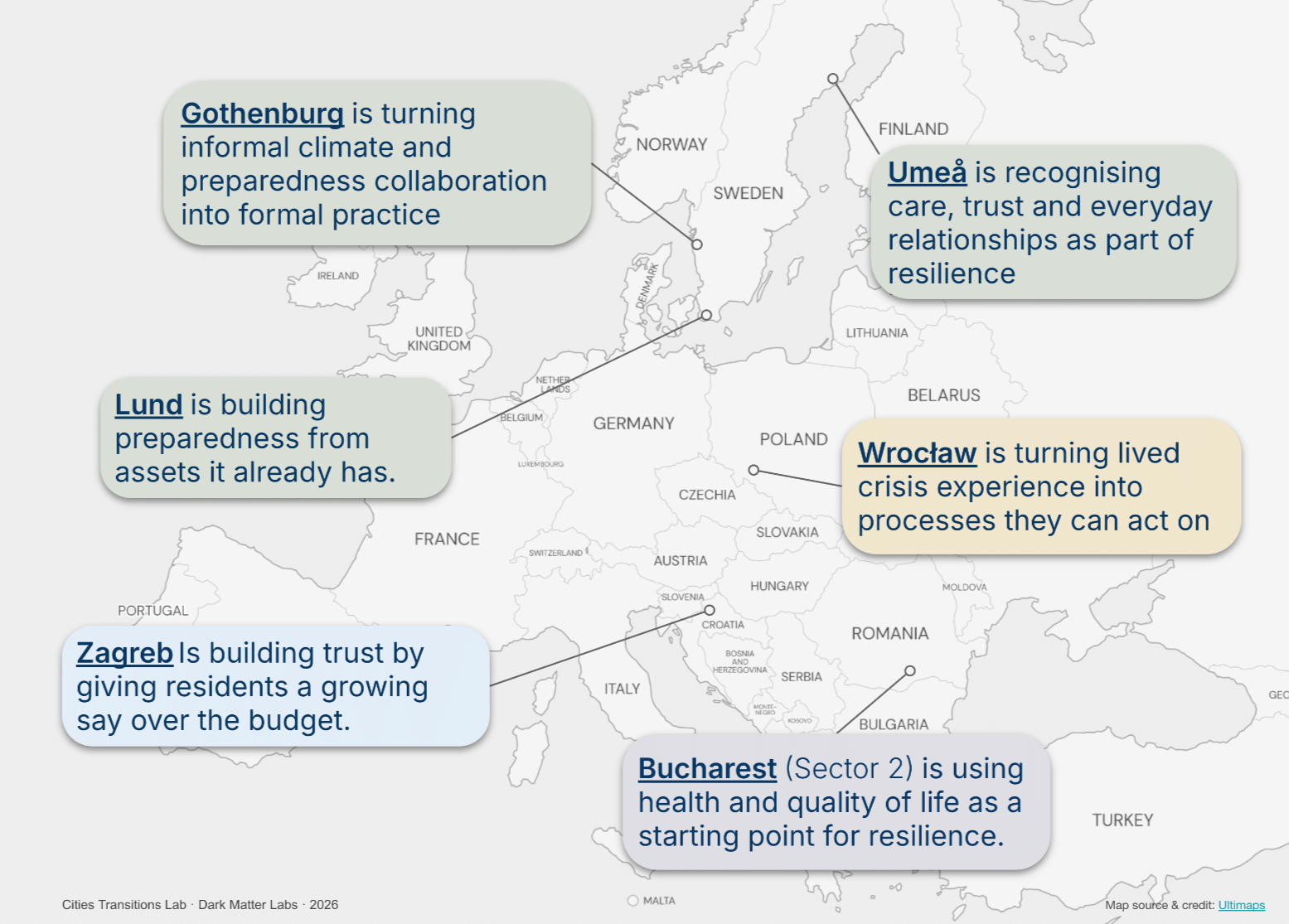
Six Mission Cities, six starting points for connecting climate action and preparedness.
3. Cities rely on social resilience but rarely treat it as infrastructure
Neighbours, local organisations and informal networks help people adapt and support one another under pressure. Some cities are starting to recognise this, but it usually sits outside resilience planning and budgets. That raises the question of how a city can strengthen community capacity without trying to own or control it.
4. The costs and benefits of resilience fall in different places
Resilience investments often create value across departments, organisations, owners and time horizons. One department may pay while another benefits; upstream interventions may protect multiple properties; and asset upgrades can create everyday and emergency value. Budgets, however, are rarely organised around these shared benefits.
Starting from what is already there
Each city is working on resilience from a different starting point. In Lund, there are eight municipal schools designated as continuity points; in Gothenburg it began with a conversation over coffee between four directors; in Wrocław, historical experience of flooding and recent population movements shape the crisis management and resilience practices.
Rather than looking for new plans or infrastructure, the conversations asked what capacities cities already have, how they are being adapted, and where stronger connections could help them respond to both climate risks and sudden disruption.
“We think in dual-use terms all the time.” – Anne Pivén, Preparedness Coordinator, Lund
Looking for more?
Six cities can only offer a partial view of the wider Mission landscape. Our aim was to highlight recurring patterns, tensions and possibilities that other cities can recognise themselves in, challenge and build on.
Download ‘Securing Urban Futures’ to read the full city stories, including what made each practice possible, where it gets difficult, and what another city could take from it.
If you have questions about this work or you’d like to take any of this forward in practice, express your interest here.